Cortex Data Lake
Palo Alto Networks Strata Logging Service XSOAR Connector provides cloud-based, centralized log storage and aggregation for your organization on premise, virtual (private cloud and public cloud) firewalls, for Prisma Access, and for cloud-delivered services such as Cortex XDR.
Analytics & SIEM · Strata Logging Service by Palo Alto Networks
Details
| ID | Cortex Data Lake |
|---|---|
| Provider | Palo Alto Networks |
| Category | Analytics & SIEM |
| From Version | 5.0.0 |
| Docker Image | demisto/python_pancloud_v2:1.0.0.11206988 |
| Supported Modules | Agentix |
README
Overview
Palo Alto Networks Strata Logging Service XSOAR Connector provides cloud-based, centralized log storage and aggregation for your on premise, virtual (private cloud and public cloud) firewalls, for Prisma Access, and for cloud-delivered services such as Cortex XDR.
This integration was integrated and tested with version 2 of Strata Logging Service XSOAR Connector.
Configure Strata Logging Service XSOAR Connector on Cortex XSOAR
-
Go to the Palo Alto Networks HUB and select and add the Cortex XSOAR app as described here.
The following screen will appear: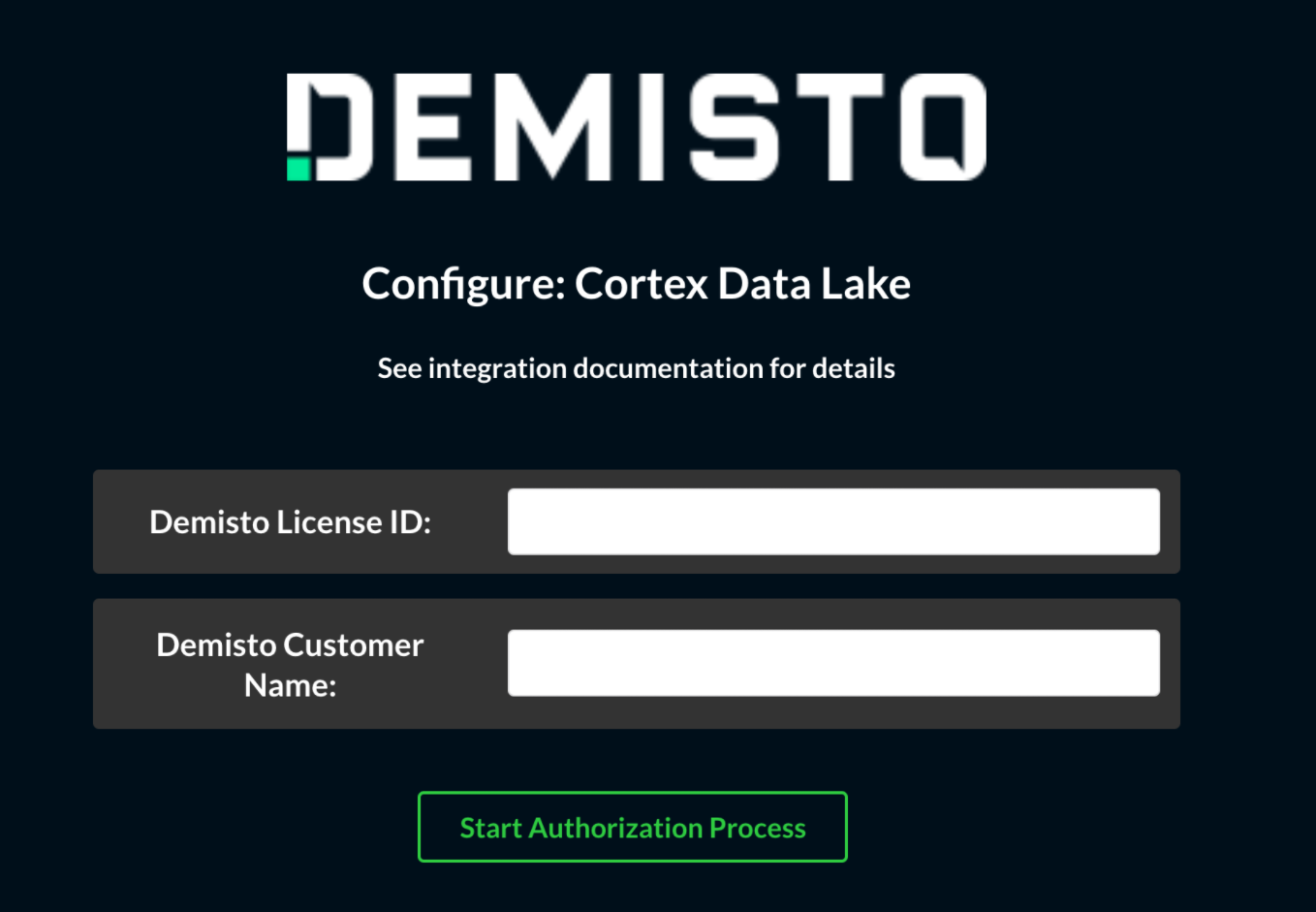
- In the Palo Alto Networks Cortex XSOAR Playground or War Room, run the !GetLicenseID command to get the License ID.
The License ID will be used in Step 4. -
(Cortex XOAR 6.x) Go to Settings > ABOUT > License and get the value in the license field Customer name.
(Cortex xSOAR 8, Administrators only ) Go to Profile > ABOUT and get the value in the license field Customer name.
The Customer name will be used in Step 4.
- In the Palo Alto Networks HUB, enter the License ID and the Customer name in the screen obtained in Step 1. The License ID and Customer name were obtained in Steps 2 and 3. Click Start Authorization Process to get the Authentication Token, Registration ID, and Encryption Key - these three fields will be used in the Palo Alto Networks Cortex v2 integration instance in Step 7 below.
- In Palo Alto Networks Cortex XSOAR, navigate to Settings > Integrations > Servers & Services.
- Search for Strata Logging Service XSOAR Connector.
- Click Add instance to create and configure a new integration instance.
- Name: A textual name for the integration instance.
- Authentication Token: Retrieved in the authentication process in Step 4.
- Registration ID: Retrieved in the authentication process in Step 4.
- The token retrieval URL is inferred based on the tenant’s FedRAMP status unless explicitly specified in the Registration ID parameter in the format
REGISTRATION_ID@URL.
- The token retrieval URL is inferred based on the tenant’s FedRAMP status unless explicitly specified in the Registration ID parameter in the format
- Encryption Key: Retrieved in the authentication process in Step 4.
- Fetch incidents: Whether to fetch incidents or not.
- first_fetch_timestamp: First fetch time (<number> <time unit>, e.g., 12 hours, 7 days, 3 months, 1 year).
- Fetch Table: Choose the table from which incidents will be fetched.
- Severity of events to fetch (Firewall): Select from all, Critical, High, Medium,Low, Informational, Unused.
- Subtype of events to fetch (Firewall): Select from all, attack, url, virus, spyware, vulnerability, file, scan, flood, packet, resource, data, url-content, wildfire, extpcap, wildfire-virus, http-hdr-insert, http-hdr, email-hdr, spyware-dns, spyware-wildfire-dns, spyware-wpc-dns, spyware-custom-dns, spyware-cloud-dns, spyware-raven, spyware-wildfire-raven, spyware-wpc-raven, wpc-virus,sctp
- Fetch Fields: Comma-separated fields that will be fetched with every incident, e.g., “pcap,session_id”. Enter “*” for all possible fields.
- Fetch Filter: Specify the filter that should be used to fetch incidents. Can not be used in combination with the Subtype and Severity parameters.
- Incidents fetched per query: How many incidents will be fetched per query. Caution: high number could create overload. Default is 10.
- proxy: Use system proxy settings.
- insecure: Trust any certificate (not secure).
- Click Test to validate the URLs, token, and connection.
In order for the integration to work, the following URLs need to be accessible:
- For authentication:
oproxy.demisto.ninjaapi.paloaltonetworks.com
- For API requests, one of the following:
- US:
api.us.cdl.paloaltonetworks.com - EU:
api.nl.cdl.paloaltonetworks.com
- US:
Fetched Incidents Data
The integration can fetch incidents from the following tables:
- firewall.auth
- firewall.decryption
- firewall.extpcap
- firewall.file_data
- firewall.globalprotect
- firewall.hipmatch
- firewall.iptag
- firewall.threat
- firewall.traffic
- firewall.url
- firewall.userid
- log.system
- log.config
CDL Server - API Calls Caching Mechanism
The integration implements a caching mechanism for repetitive error when requesting access token from CDL server.
When the integration reaches the limit of allowed calls, the following error will be shown:
We have found out that your recent attempts to authenticate against the CDL server have failed. Therefore we have limited the number of calls that the CDL integration performs.
The integration will re-attempt authentication if the command was called under the following cases:
- First hour - once every minute.
- First 48 hours - once in 10 minutes.
- After that every 60 minutes.
If you wish to try authenticating again, run the ‘cdl-reset-authentication-timeout’ command and retry.
Commands
You can execute these commands from the Cortex XSOAR CLI, as part of an automation, or in a playbook.
After you successfully execute a command, a DBot message appears in the War Room with the command details.
- cdl-query-logs
- cdl-get-critical-threat-logs
- cdl-get-social-applications
- cdl-search-by-file-hash
- cdl-query-traffic-logs
- cdl-query-threat-logs
- cdl-query-url-logs
- cdl-query-file-data
- cdl-reset-authentication-timeout
- cdl-query-gp-logs
- sls-query-logs
- sls-get-critical-threat-logs
- sls-get-social-applications
- sls-search-by-file-hash
- sls-query-traffic-logs
- sls-query-threat-logs
- sls-query-url-logs
- sls-query-file-data
- sls-query-gp-logs
1. cdl-query-logs
Runs a query on the Cortex logging service.
Base Command
cdl-query-logs
Input
| Argument Name | Description | Required |
|---|---|---|
| query | A free-text SQL query. For example, query=”SELECT * FROM `firewall.traffic` limit 10”. There are multiple tables in Loggings, for example: threat, traffic, and so on. Refer to the Cortex Logging service schema reference for the full list. | Optional |
| limit | The number of logs to return. Default is 10 | Optional |
| page | Page to return. | Optional |
| page_size | Number of entries per page. Defaults to 50 (in case only page was provided). | Optional |
| transform_results | If set to false, query results are not mapped into the standard command context. Default is “true”. | Optional |
Context Output
| Path | Type | Description |
|---|---|---|
| CDL.Logging.Action | String | Identifies the action that the firewall took for the network traffic. |
| CDL.Logging.App | String | Application associated with the network traffic. |
| CDL.Logging.Protocol | String | IP protocol associated with the session. |
| CDL.Logging.DestinationIP | String | Original destination IP address. |
| CDL.Logging.RuleMatched | String | Name of the security policy rule that the network traffic matched. |
| CDL.Logging.CharacteristicOfApp | Number | Identifies the behavioral characteristic of the application associated with the network traffic. |
| CDL.Logging.LogSourceName | String | Name of the source of the log. |
| CDL.Logging.IsNat | number | Indicates if the firewall is performing network address translation (NAT) for the logged traffic. |
| CDL.Logging.NatDestinationPort | Number | Post-NAT destination port. |
| CDL.Logging.NatDestination | String | If destination NAT performed, the post-NAT destination IP address. |
| CDL.Logging.NatSource | String | If source NAT was performed, the post-NAT source IP address. |
| CDL.Logging.SourceIP | String | Original source IP address. |
| CDL.Logging.AppCategory | String | Identifies the high-level family of the application. |
| CDL.Logging.SourceLocation | String | Source country or internal region for private addresses. |
| CDL.Logging.DestinationLocation | String | Destination country or internal region for private addresses. |
| CDL.Logging.FileSHA256 | String | The binary hash (SHA256) of the file sent for virus analysis. |
| CDL.Logging.FileName | String | The name of the infected file. |
| CDL.Logging.TimeGenerated | Date | Time when the log was generated on the firewall’s data plane. |
Command Example
!cdl-query-logs query="SELECT * FROM `firewall.traffic` limit 1"
Context Example
{
  "CDL.Logging": [
    {
      "Action": "allow",
      "App": "smtp",
      "Protocol": "tcp",
      "DestinationIP": "206.116.22.23",
      "RuleMatched": "taplog",
      "CharacteristicOfApp": [
        "3",
        "4",
        "5",
        "6",
        "7",
        "8"
      ],
      "LogSourceName": "gw",
      "NatDestination": "0.0.0.0",
      "NatSource": "0.0.0.0",
      "SourceIP": "10.154.1.20",
      "AppCategory": "collaboration",
      "SourceLocation": "10.0.0.0-10.255.255.255",
      "DestinationLocation": "CA",
      "TimeGenerated": "2020-03-18T19:36:37"
    }
  ]
}
Human Readable Output
Logs traffic table
| Action | App | AppCategory | CharacteristicOfApp | DestinationIP | DestinationLocation | LogSourceName | NatDestination | NatSource | Protocol | RuleMatched | SourceIP | SourceLocation | TimeGenerated |
|---|---|---|---|---|---|---|---|---|---|---|---|---|---|
| allow | smtp | collaboration | 3,4,5,6,7,8 | 206.116.22.23 | CA | gw | 0.0.0.0 | 0.0.0.0 | tcp | taplog | 10.154.1.20 | 10.0.0.0-10.255.255.255 | 2020-03-18T19:36:37 |
2. cdl-get-critical-threat-logs
Runs a query on the Cortex logging service, according to preset queries.
Base Command
cdl-get-critical-threat-logs
Input
| Argument Name | Description | Required |
|---|---|---|
| start_time | The query start time. For example, start_time=”2018-04-26 00:00:00” | Optional |
| end_time | The query end time. For example, end_time=”2018-04-26 00:00:00” | Optional |
| limit | The number of logs to return. Default is 10 | Optional |
| page | Page to return. | Optional |
| page_size | Number of entries per page. Defaults to 50 (in case only page was provided). | Optional |
| time_range | First log time (<number> <time unit>, e.g., 12 hours, 7 days, 3 months, 1 year) | Optional |
Context Output
| Path | Type | Description |
|---|---|---|
| CDL.Logging.Threat.SessionID | String | Identifies the firewall’s internal identifier for a specific network session. |
| CDL.Logging.Threat.Action | String | Identifies the action that the firewall took for the network traffic. |
| CDL.Logging.Threat.App | String | Application associated with the network traffic. |
| CDL.Logging.Threat.Nat | String | Indicates whether the firewall is performing network address translation (NAT) for the logged traffic. If it is, this value is 1. |
| CDL.Logging.Threat.SubcategoryOfApp | String | Identifies the application’s subcategory. The subcategory is related to the application’s category, which is identified in category_of_app. |
| CDL.Logging.Threat.PcapID | String | Packet capture (pcap) ID. This is used to correlate threat pcap files with extended pcaps taken as a part of the session flow. All threat logs will contain either a pcap_id of 0 (no associated pcap) , or an ID referencing the extended pcap file. |
| CDL.Logging.Threat.Natdst | String | If destination NAT performed, the post-NAT destination IP address. The IP address is an IPv4/IPv6 address in hex format. |
| CDL.Logging.Threat.Flags | String | Bit field which provides details on the session, such as whether the session use IPv6, whether the session was denied due to a URL filtering rule, and/or whether the log corresponds to a transaction within an HTTP proxy session. |
| CDL.Logging.Threat.Dport | String | Network traffic’s destination port. If this value is 0, then the app is using its standard port. |
| CDL.Logging.Threat.ThreatID | String | Numerical identifier for the threat type. All threats encountered by Palo Alto Networks firewalls are assigned a unique identifier |
| CDL.Logging.Threat.Natsrc | String | If source NAT was performed, the post-NAT source IP address. The IP address is an IPv4/IPv6 address in hex format. |
| CDL.Logging.Threat.CategoryOfApp | String | Identifies the managing application, or parent, of the application associated with this network traffic, if any. |
| CDL.Logging.Threat.Srcloc | String | Source country or internal region for private addresses. The internal region is a user-defined name for a specific network in the user’s enterprise. |
| CDL.Logging.Threat.Dstloc | String | Destination country or internal region for private addresses. The internal region is a user-defined name for a specific network in the user’s enterprise. |
| CDL.Logging.Threat.To | String | Networking zone to which the traffic was sent. |
| CDL.Logging.Threat.RiskOfApp | String | Indicates how risky the application is from a network security perspective. Values range from 1-5, where 5 is the riskiest. |
| CDL.Logging.Threat.Natsport | String | Post-NAT source port. |
| CDL.Logging.Threat.URLDenied | String | Session was denied due to a URL filtering rule. |
| CDL.Logging.Threat.CharacteristicOfApp | String | Identifies the behavioral characteristic of the application associated with the network traffic. |
| CDL.Logging.Threat.HTTPMethod | String | Only in URL filtering logs. Describes the HTTP Method used in the web request |
| CDL.Logging.Threat.From | String | The networking zone from which the traffic originated. |
| CDL.Logging.Threat.Vsys | String | Virtual system associated with the network traffic. |
| CDL.Logging.Threat.ReceiveTime | String | Time the log was received at the management plane. |
| CDL.Logging.Threat.Users | String | Srcuser or dstuser or srcip (one of). |
| CDL.Logging.Threat.Proto | String | IP protocol associated with the session. |
| CDL.Logging.Threat.Natdport | String | Post-NAT destination port. |
| CDL.Logging.Threat.Dst | String | Original destination IP address. The IP address is an IPv4/ IPv6 address in hex format. |
| CDL.Logging.Threat.Rule | String | Name of the security policy rule that the network traffic matched. |
| CDL.Logging.Threat.CategoryOfThreatID | String | Threat category of the detected threat. |
| CDL.Logging.Threat.DeviceName | String | The hostname of the firewall that logged the network traffic. |
| CDL.Logging.Threat.Subtype | String | Subtype of the threat log. |
| CDL.Logging.Threat.TimeReceived | String | Time the log was received at the management plane. |
| CDL.Logging.Threat.Direction | String | Indicates the direction of the attack, client-to-server or server-to-client: |
| CDL.Logging.Threat.Misc | String | The meaning of this field differs according to the log’s subtype: Subtype is URL, this field contains the requested URI. Subtype is File, this field contains the file name or file type. Subtype is Virus, this field contains the file name. Subtype is WildFire, this field contains the file name. |
| CDL.Logging.Threat.Severity | String | Severity associated with the event. |
| CDL.Logging.Threat.Src | String | Original source IP address. The IP address is an IPv4/IPv6 address in hex format. |
| CDL.Logging.Threat.TimeGenerated | String | Time the log was generated on the data plane. |
| CDL.Logging.Threat.Serial | String | Serial number of the firewall that generated the log. |
| CDL.Logging.Threat.VsysID | String | A unique identifier for a virtual system on a Palo Alto Networks firewall. |
| CDL.Logging.Threat.URLDomain | String | The name of the internet domain that was visited in this session. |
| CDL.Logging.Threat.Category | String | For the URL subtype, this identifies the URL Category. For the WildFire subtype, this identifies the verdict on the file. It is one of ‘malicious’, ‘phishing’, ‘grayware’, or ‘benign’; |
| CDL.Logging.Threat.Sport | String | Source port utilized by the session. |
| CDL.Logging.Threat.IsPhishing | Boolean | Detected enterprise credential submission by an end user. |
| IP.Address | String | IP address. |
| Domain.Name | String | The domain name, for example: “google.com”. |
| File.SHA256 | String | The SHA256 hash of the file. |
| File.Name | String | The full file name (including file extension). |
| File.Type | String | The file type, as determined by libmagic (same as displayed in file entries). |
Command Example
!cdl-get-critical-threat-logs limit="1" time_range="10 days"
Context Example
{
  "CDL.Logging.Threat": [
    {
      "SessionID": 103986,
      "Action": "reset-both",
      "App": "imap",
      "IsNat": false,
      "SubcategoryOfApp": "email",
      "PcapID": 0,
      "NatDestination": "0.0.0.0",
      "Flags": 8192,
      "DestinationPort": 143,
      "ThreatID": 30663,
      "NatSource": "0.0.0.0",
      "IsURLDenied": false,
      "Users": "10.154.10.88",
      "TimeGenerated": "2020-03-18T15:46:10",
      "IsPhishing": false,
      "AppCategory": "collaboration",
      "SourceLocation": "10.0.0.0-10.255.255.255",
      "DestinationLocation": "CH",
      "ToZone": "TapZone",
      "RiskOfApp": 4,
      "NatSourcePort": 0,
      "CharacteristicOfApp": [
        "3",
        "4",
        "5",
        "8"
      ],
      "FromZone": "TapZone",
      "Vsys": "vsys1",
      "Protocol": "tcp",
      "NatDestinationPort": 0,
      "DestinationIP": "84.74.104.27",
      "SourceIP": "10.154.10.88",
      "RuleMatched": "taplog",
      "ThreatCategory": "overflow",
      "LogSourceName": "gw",
      "Subtype": "vulnerability",
      "Direction": "server to client",
      "FileName": "iZJvnxT27.PpT",
      "VendorSeverity": "Critical",
      "LogTime": "2020-03-18T15:46:37",
      "LogSourceID": "007251000070976",
      "VsysID": 1,
      "URLDomain": null,
      "URLCategory": "any",
      "SourcePort": 14484
    }
  ]
}
Human Readable Output
Logs threat table
| Action | App | AppCategory | CharacteristicOfApp | DestinationIP | DestinationLocation | DestinationPort | Direction | FileName | Flags | FromZone | IsNat | IsPhishing | IsURLDenied | LogSourceID | LogSourceName | LogTime | NatDestination | NatDestinationPort | NatSource | NatSourcePort | PcapID | Protocol | RiskOfApp | RuleMatched | SessionID | SourceIP | SourceLocation | SourcePort | SubcategoryOfApp | Subtype | ThreatCategory | ThreatID | TimeGenerated | ToZone | URLCategory | URLDomain | Users | VendorSeverity | Vsys | VsysID |
|---|---|---|---|---|---|---|---|---|---|---|---|---|---|---|---|---|---|---|---|---|---|---|---|---|---|---|---|---|---|---|---|---|---|---|---|---|---|---|---|---|
| reset-both | imap | collaboration | 3,4,5,8 | 84.74.104.27 | CH | 143 | server to client | iZJvnxT27.PpT | 8192 | TapZone | false | false | false | 007251000070976 | gw | 2020-03-18T15:46:37 | 0.0.0.0 | 0 | 0.0.0.0 | 0 | 0 | tcp | 4 | taplog | 103986 | 10.154.10.88 | 10.0.0.0-10.255.255.255 | 14484 | vulnerability | overflow | 30663 | 2020-03-18T15:46:10 | TapZone | any | 10.154.10.88 | Critical | vsys1 | 1 |
3. cdl-get-social-applications
Runs a query on the Cortex logging service, according to preset queries.
Base Command
cdl-get-social-applications
Input
| Argument Name | Description | Required |
|---|---|---|
| start_time | Query start time. For example, start_time=”2018-04-26 00:00:00” | Optional |
| end_time | Query end time. For example, end_time=”2018-04-26 00:00:00” | Optional |
| limit | Amount of logs. Default is 10 | Optional |
| page | Page to return. | Optional |
| page_size | Number of entries per page. Defaults to 50 (in case only page was provided). | Optional |
| time_range | First log time (<number> <time unit>, e.g., 12 hours, 7 days, 3 months, 1 year) | Optional |
Context Output
| Path | Type | Description |
|---|---|---|
| CDL.Logging.Traffic.Action | String | Identifies the action that the firewall took for the network traffic. |
| CDL.Logging.Traffic.RiskOfApp | String | Indicates how risky the application is from a network security perspective. |
| CDL.Logging.Traffic.NatSourcePort | String | Post-NAT source port. |
| CDL.Logging.Traffic.SessionID | String | Identifies the firewall’s internal identifier for a specific network session. |
| CDL.Logging.Traffic.Packets | String | Number of total packets (transmit and receive) seen for the session. |
| CDL.Logging.Traffic.CharacteristicOfApp | String | Identifies the behavioral characteristic of the application associated with the network traffic. |
| CDL.Logging.Traffic.App | String | Application associated with the network traffic. |
| CDL.Logging.Traffic.Vsys | String | Virtual system associated with the network traffic. |
| CDL.Logging.Traffic.IsNat | String | Indicates whether the firewall is performing network address translation (NAT) for the logged traffic. If it is, this value is 1. |
| CDL.Logging.Traffic.LogTime | date | Time the log was received in Strata Logging Service XSOAR Connector. |
| CDL.Logging.Traffic.SubcategoryOfApp | String | Identifies the application’s subcategory. The subcategory is related to the application’s category, |
| CDL.Logging.Traffic.Protocol | String | IP protocol associated with the session. |
| CDL.Logging.Traffic.NatDestinationPort | String | Post-NAT destination port. |
| CDL.Logging.Traffic.DestinationIP | String | Original destination IP address. |
| CDL.Logging.Traffic.NatDestination | String | If destination NAT performed, the post-NAT destination IP address. |
| CDL.Logging.Traffic.RuleMatched | String | Name of the security policy rule that the network traffic matched. |
| CDL.Logging.Traffic.DestinationPort | String | Network traffic’s destination port. If this value is 0, then the app is using its standard port. |
| CDL.Logging.Traffic.TotalTimeElapsed | String | Total time taken for the network session to complete. |
| CDL.Logging.Traffic.LogSourceName | String | Device name of the source of the log |
| CDL.Logging.Traffic.Subtype | String | The log sub type. |
| CDL.Logging.Traffic.Users | String | Source/Destination user. If neither is available, source_ip is used. |
| CDL.Logging.Traffic.TunneledApp | String | Is app tunneled. |
| CDL.Logging.Traffic.IsPhishing | String | Indicates whether enterprise credentials were submitted by an end user. |
| CDL.Logging.Traffic.SessionEndReason | String | The reason a session terminated. |
| CDL.Logging.Traffic.NatSource | String | If source NAT was performed, the post-NAT source IP address. |
| CDL.Logging.Traffic.SourceIP | String | Original source IP address. |
| CDL.Logging.Traffic.SessionStartIP | date | Time when the session was established. |
| CDL.Logging.Traffic.TimeGenerated | date | Time when the log was generated on the firewall’s data plane. |
| CDL.Logging.Traffic.AppCategory | String | Identifies the high-level family of the application. |
| CDL.Logging.Traffic.SourceLocation | String | Source country or internal region for private addresses. |
| CDL.Logging.Traffic.DestinationLocation | String | Destination country or internal region for private addresses. |
| CDL.Logging.Traffic.LogSourceID | String | ID that uniquely identifies the source of the log. If the source is a firewall, this is its serial number. |
| CDL.Logging.Traffic.TotalBytes | String | Number of total bytes (transmit and receive). |
| CDL.Logging.Traffic.VsysID | String | A unique identifier for a virtual system on a Palo Alto Networks firewall. |
| CDL.Logging.Traffic.ToZone | String | Networking zone to which the traffic was sent. |
| CDL.Logging.Traffic.URLCategory | String | The URL category. |
| CDL.Logging.Traffic.SourcePort | String | Source port utilized by the session. |
| CDL.Logging.Traffic.Tunnel | String | Type of tunnel. |
Command Example
!cdl-get-social-applications limit="2" time_range="10 days"
Context Example
{
  "CDL.Logging.Traffic": [
    {
      "Action": "allow",
      "RiskOfApp": 4,
      "SessionID": 108356,
      "Packets": 7,
      "CharacteristicOfApp": [
        "3",
        "4",
        "5",
        "6",
        "8"
      ],
      "App": "facebook-base",
      "Vsys": "vsys1",
      "LogTime": "2020-03-18T15:54:40",
      "SubcategoryOfApp": "social-networking",
      "Protocol": "tcp",
      "DestinationIP": "131.130.159.25",
      "NatDestination": "0.0.0.0",
      "RuleMatched": "taplog",
      "DestinationPort": 80,
      "LogSourceName": "gw",
      "Subtype": "start",
      "Users": "10.154.230.43",
      "TunneledApp": "tunneled-app",
      "SessionEndReason": "n-a",
      "NatSource": "0.0.0.0",
      "SourceIP": "10.154.230.43",
      "SessionStartIP": "2020-03-18T15:54:14",
      "TimeGenerated": "2020-03-18T15:54:16",
      "AppCategory": "collaboration",
      "SourceLocation": "10.0.0.0-10.255.255.255",
      "DestinationLocation": "AT",
      "LogSourceID": "007251000070976",
      "TotalBytes": 946,
      "VsysID": 1,
      "ToZone": "TapZone",
      "URLCategory": "social-networking",
      "SourcePort": 37252,
      "Tunnel": "N/A"
    },
    {
      "Action": "allow",
      "RiskOfApp": 4,
      "SessionID": 276377,
      "Packets": 768,
      "CharacteristicOfApp": [
        "3",
        "4",
        "5",
        "6",
        "8"
      ],
      "App": "facebook-base",
      "Vsys": "vsys1",
      "LogTime": "2020-03-16T15:54:36",
      "SubcategoryOfApp": "social-networking",
      "Protocol": "tcp",
      "DestinationIP": "213.191.250.86",
      "NatDestination": "0.0.0.0",
      "RuleMatched": "taplog",
      "DestinationPort": 80,
      "TotalTimeElapsed": 1,
      "LogSourceName": "gw",
      "Subtype": "end",
      "Users": "10.154.227.21",
      "TunneledApp": "tunneled-app",
      "SessionEndReason": "tcp-fin",
      "NatSource": "0.0.0.0",
      "SourceIP": "10.154.227.21",
      "SessionStartIP": "2020-03-16T15:53:58",
      "TimeGenerated": "2020-03-16T15:54:16",
      "AppCategory": "collaboration",
      "SourceLocation": "10.0.0.0-10.255.255.255",
      "DestinationLocation": "IE",
      "LogSourceID": "007251000070976",
      "TotalBytes": 384468,
      "VsysID": 1,
      "ToZone": "TapZone",
      "URLCategory": "social-networking",
      "SourcePort": 53174,
      "Tunnel": "N/A"
    }
  ]
}
Human Readable Output
Logs traffic table
Logs traffic table
| Action | App | AppCategory | CharacteristicOfApp | DestinationIP | DestinationLocation | DestinationPort | LogSourceID | LogSourceName | LogTime | NatDestination | NatSource | Packets | Protocol | RiskOfApp | RuleMatched | SessionEndReason | SessionID | SessionStartIP | SourceIP | SourceLocation | SourcePort | SubcategoryOfApp | Subtype | TimeGenerated | ToZone | TotalBytes | Tunnel | TunneledApp | URLCategory | Users | Vsys | VsysID |
|---|---|---|---|---|---|---|---|---|---|---|---|---|---|---|---|---|---|---|---|---|---|---|---|---|---|---|---|---|---|---|---|---|
| allow | facebook-base | collaboration | 3,4,5,6,8 | 131.130.159.25 | AT | 80 | 007251000070976 | gw | 2020-03-18T15:54:40 | 0.0.0.0 | 0.0.0.0 | 7 | tcp | 4 | taplog | n-a | 108356 | 2020-03-18T15:54:14 | 10.154.230.43 | 10.0.0.0-10.255.255.255 | 37252 | social-networking | start | 2020-03-18T15:54:16 | TapZone | 946 | N/A | tunneled-app | social-networking | 10.154.230.43 | vsys1 | 1 |
| allow | facebook-base | collaboration | 3,4,5,6,8 | 213.191.250.86 | IE | 80 | 007251000070976 | gw | 2020-03-16T15:54:36 | 0.0.0.0 | 0.0.0.0 | 768 | tcp | 4 | taplog | tcp-fin | 276377 | 2020-03-16T15:53:58 | 10.154.227.21 | 10.0.0.0-10.255.255.255 | 53174 | social-networking | end | 2020-03-16T15:54:16 | TapZone | 384468 | N/A | tunneled-app | social-networking | 10.154.227.21 | vsys1 | 1 |
4. cdl-search-by-file-hash
Runs a query on the threat table with the query ‘SELECT * FROM firewall.threat WHERE file_sha_256 = '
Base Command
cdl-search-by-file-hash
Input
| Argument Name | Description | Required |
|---|---|---|
| start_time | The query start time. For example, start_time=”2018-04-26 00:00:00” | Optional |
| end_time | The query end time. For example, end_time=”2018-04-26 00:00:00” | Optional |
| limit | The number of logs to return. Default is 10. | Optional |
| page | Page to return. | Optional |
| page_size | Number of entries per page. Defaults to 50 (in case only page was provided). | Optional |
| time_range | First log time (<number> <time unit>, e.g., 12 hours, 7 days, 3 months, 1 year) | Optional |
| SHA256 | The SHA256 hash of the file for the query. For example, SHA256=”503ca1a4fc0d48b18c0336f544ba0f0abf305ae3a3f49b3c2b86b8645d6572dc” would return all logs associated with this file. | Required |
Context Output
| Path | Type | Description |
|---|---|---|
| CDL.Logging.Threat.SessionID | String | Identifies the firewall’s internal identifier for a specific network session. |
| CDL.Logging.Threat.Action | String | Identifies the action that the firewall took for the network traffic. |
| CDL.Logging.Threat.App | String | Application associated with the network traffic. |
| CDL.Logging.Threat.Nat | String | Indicates whether the firewall is performing network address translation (NAT) for the logged traffic. If it is, this value is 1. |
| CDL.Logging.Threat.SubcategoryOfApp | String | Identifies the application’s subcategory. The subcategory is related to the application’s category, which is identified in category_of_app. |
| CDL.Logging.Threat.PcapID | String | Packet capture (pcap) ID. This is used to correlate threat pcap files with extended pcaps taken as a part of the session flow. All threat logs will contain either a pcap_id of 0 (no associated pcap) , or an ID referencing the extended pcap file. |
| CDL.Logging.Threat.Natdst | String | If destination NAT performed, the post-NAT destination IP address. The IP address is an IPv4/IPv6 address in hex format. |
| CDL.Logging.Threat.Flags | String | Bit field which provides details on the session, such as whether the session use IPv6, whether the session was denied due to a URL filtering rule, and/or whether the log corresponds to a transaction within an HTTP proxy session. |
| CDL.Logging.Threat.Dport | String | Network traffic’s destination port. If this value is 0, then the app is using its standard port. |
| CDL.Logging.Threat.ThreatID | String | Numerical identifier for the threat type. All threats encountered by Palo Alto Networks firewalls are assigned a unique identifier |
| CDL.Logging.Threat.Natsrc | String | If source NAT was performed, the post-NAT source IP address. The IP address is an IPv4/IPv6 address in hex format. |
| CDL.Logging.Threat.CategoryOfApp | String | Identifies the managing application, or parent, of the application associated with this network traffic, if any. |
| CDL.Logging.Threat.Srcloc | String | Source country or internal region for private addresses. The internal region is a user-defined name for a specific network in the user’s enterprise. |
| CDL.Logging.Threat.Dstloc | String | Destination country or internal region for private addresses. The internal region is a user-defined name for a specific network in the user’s enterprise. |
| CDL.Logging.Threat.To | String | Networking zone to which the traffic was sent. |
| CDL.Logging.Threat.RiskOfApp | String | Indicates how risky the application is from a network security perspective. Values range from 1-5, where 5 is the riskiest. |
| CDL.Logging.Threat.Natsport | String | Post-NAT source port. |
| CDL.Logging.Threat.URLDenied | String | Session was denied due to a URL filtering rule. |
| CDL.Logging.Threat.CharacteristicOfApp | String | Identifies the behavioral characteristic of the application associated with the network traffic. |
| CDL.Logging.Threat.HTTPMethod | String | Only in URL filtering logs. Describes the HTTP Method used in the web request |
| CDL.Logging.Threat.From | String | The networking zone from which the traffic originated. |
| CDL.Logging.Threat.Vsys | String | Virtual system associated with the network traffic. |
| CDL.Logging.Threat.ReceiveTime | String | Time the log was received at the management plane. |
| CDL.Logging.Threat.Users | String | Srcuser or dstuser or srcip (one of). |
| CDL.Logging.Threat.Proto | String | IP protocol associated with the session. |
| CDL.Logging.Threat.Natdport | String | Post-NAT destination port. |
| CDL.Logging.Threat.Dst | String | Original destination IP address. The IP address is an IPv4/ IPv6 address in hex format. |
| CDL.Logging.Threat.Rule | String | Name of the security policy rule that the network traffic matched. |
| CDL.Logging.Threat.CategoryOfThreatID | String | Threat category of the detected threat. |
| CDL.Logging.Threat.DeviceName | String | The hostname of the firewall that logged the network traffic. |
| CDL.Logging.Threat.Subtype | String | Subtype of the threat log. |
| CDL.Logging.Threat.TimeReceived | String | Time the log was received at the management plane. |
| CDL.Logging.Threat.Direction | String | Indicates the direction of the attack, client-to-server or server-to-client: |
| CDL.Logging.Threat.Misc | String | The meaning of this field differs according to the log’s subtype: Subtype is URL, this field contains the requested URI. Subtype is File, this field contains the file name or file type. Subtype is Virus, this field contains the file name. Subtype is WildFire, this field contains the file name. |
| CDL.Logging.Threat.Severity | String | Severity associated with the event. |
| CDL.Logging.Threat.Src | String | Original source IP address. The IP address is an IPv4/IPv6 address in hex format. |
| CDL.Logging.Threat.TimeGenerated | String | Time the log was generated on the data plane. |
| CDL.Logging.Threat.Serial | String | Serial number of the firewall that generated the log. |
| CDL.Logging.Threat.VsysID | String | A unique identifier for a virtual system on a Palo Alto Networks firewall. |
| CDL.Logging.Threat.URLDomain | String | The name of the internet domain that was visited in this session. |
| CDL.Logging.Threat.Category | String | For the URL subtype, this identifies the URL Category. For the WildFire subtype, this identifies the verdict on the file. It is one of ‘malicious’, ‘phishing’, ‘grayware’, or ‘benign’; |
| CDL.Logging.Threat.Sport | String | Source port utilized by the session. |
| CDL.Logging.Threat.IsPhishing | Boolean | Detected enterprise credential submission by an end user. |
| IP.Address | String | IP address. |
| Domain.Name | String | The domain name, for example: “google.com”. |
| File.SHA256 | String | The SHA256 hash of the file. |
| File.Name | String | The full file name (including file extension). |
| File.Type | String | The file type, as determined by libmagic (same as displayed in file entries). |
Command Example
!cdl-search-by-file-hash SHA256="cbdf1f3cccd949e6e96c425b3d7ccc463b956f002f694472e4d24a12ff2cea4d" limit=1 time_range="10 days"
Context Example
{
  "CDL.Logging.Threat": [
    {
      "SessionID": 784600,
      "Action": "block",
      "App": "smtp",
      "IsNat": false,
      "SubcategoryOfApp": "email",
      "PcapID": 0,
      "NatDestination": "0.0.0.0",
      "Flags": 8192,
      "DestinationPort": 25,
      "ThreatID": 52033,
      "NatSource": "0.0.0.0",
      "IsURLDenied": false,
      "Users": "10.154.246.167",
      "TimeGenerated": "2020-03-25T15:42:08",
      "IsPhishing": false,
      "AppCategory": "collaboration",
      "SourceLocation": "10.0.0.0-10.255.255.255",
      "DestinationLocation": "US",
      "ToZone": "TapZone",
      "RiskOfApp": 5,
      "NatSourcePort": 0,
      "CharacteristicOfApp": [
        "3",
        "4",
        "5",
        "6",
        "7",
        "8"
      ],
      "FromZone": "TapZone",
      "Vsys": "vsys1",
      "Protocol": "tcp",
      "NatDestinationPort": 0,
      "DestinationIP": "67.53.137.201",
      "SourceIP": "10.154.246.167",
      "RuleMatched": "taplog",
      "ThreatCategory": "",
      "LogSourceName": "gw",
      "Subtype": "wildfire",
      "Direction": "client to server",
      "FileName": "o93yr.ECr",
      "VendorSeverity": "Informational",
      "LogTime": "2020-03-25T15:42:13",
      "LogSourceID": "007251000070976",
      "VsysID": 1,
      "URLDomain": null,
      "URLCategory": "",
      "SourcePort": 51819,
      "FileSHA256": "cbdf1f3cccd949e6e96c425b3d7ccc463b956f002f694472e4d24a12ff2cea4d"
    }
  ]
}
Human Readable Output
Logs threat table
| Action | App | AppCategory | CharacteristicOfApp | DestinationIP | DestinationLocation | DestinationPort | Direction | FileName | FileSHA256 | Flags | FromZone | IsNat | IsPhishing | IsURLDenied | LogSourceID | LogSourceName | LogTime | NatDestination | NatDestinationPort | NatSource | NatSourcePort | PcapID | Protocol | RiskOfApp | RuleMatched | SessionID | SourceIP | SourceLocation | SourcePort | SubcategoryOfApp | Subtype | ThreatCategory | ThreatID | TimeGenerated | ToZone | URLCategory | URLDomain | Users | VendorSeverity | Vsys | VsysID |
|---|---|---|---|---|---|---|---|---|---|---|---|---|---|---|---|---|---|---|---|---|---|---|---|---|---|---|---|---|---|---|---|---|---|---|---|---|---|---|---|---|---|
| block | smtp | collaboration | 3,4,5,6,7,8 | 67.53.137.201 | US | 25 | client to server | o93yr.ECr | cbdf1f3cccd949e6e96c425b3d7ccc463b956f002f694472e4d24a12ff2cea4d | 8192 | TapZone | false | false | false | 007251000070976 | gw | 2020-03-25T15:42:13 | 0.0.0.0 | 0 | 0.0.0.0 | 0 | 0 | tcp | 5 | taplog | 784600 | 10.154.246.167 | 10.0.0.0-10.255.255.255 | 51819 | wildfire | 52033 | 2020-03-25T15:42:08 | TapZone | 10.154.246.167 | Informational | vsys1 | 1 |
5. cdl-query-traffic-logs
Searches the Cortex firewall.traffic table. Traffic logs contain entries for the end of each network session
Base Command
cdl-query-traffic-logs
Input
| Argument Name | Description | Required |
|---|---|---|
| source_ip | A source IP address or an array of source IPs addresses for which to search, for example 1.1.1.1,2.2.2.2. | Optional |
| rule | A rule name or an array of rule names to search. | Optional |
| from_zone | A source zone name or an array of source zone names to search. | Optional |
| to_zone | A destination zone name or an array of zone names to search. | Optional |
| source_port | Source port utilized by the session. Can be port number or an array of destination port numbers to search. For example ‘443’ or ‘443,445’ | Optional |
| action | An action name or an array of action names to search. | Optional |
| query | A free-text query for which to search. This forms the WHERE part of the query, for example, !cdl-query-traffic-logs query=”source_ip.value LIKE ‘192.168.1.*’ AND dest_ip.value=’8.8.8.8’ And dest_port=1234” | Optional |
| fields | The fields that are selected in the query. Selection can be “all” (same as *) or a comma separated list of specific fields in the table. | Optional |
| start_time | The query start time. For example, start_time=”2018-04-26 00:00:00” | Optional |
| end_time | The query end time. For example, end_time=”2018-04-26 00:00:00”. | Optional |
| time_range | First fetch time (<number> <time unit>, e.g., 12 hours, 7 days, 3 months, 1 year) | Optional |
| limit | The number of logs to return. Default is 5. | Optional |
| page | Page to return. | Optional |
| page_size | Number of entries per page. Defaults to 50 (in case only page was provided). | Optional |
| dest_ip | A destination IP address or an array of destination IPs addresses for which to search, for example 1.1.1.1,2.2.2.2. | Optional |
| dest_port | Destination port utilized by the session. Can be port number or an array of destination port numbers to search. For example ‘443’ or ‘443,445’ | Optional |
| ip | IP address. Enter an IP address or an array of IP addresses for which to search, for example 1.1.1.1,2.2.2.2. | Optional |
| port | Port utilized by the session. Enter a port or array of ports to search. | Optional |
Context Output
| Path | Type | Description |
|---|---|---|
| CDL.Logging.Traffic.Action | String | Identifies the action that the firewall took for the network traffic. |
| CDL.Logging.Traffic.RiskOfApp | String | Indicates how risky the application is from a network security perspective. |
| CDL.Logging.Traffic.NatSourcePort | String | Post-NAT source port. |
| CDL.Logging.Traffic.SessionID | String | Identifies the firewall’s internal identifier for a specific network session. |
| CDL.Logging.Traffic.Packets | String | Number of total packets (transmit and receive) seen for the session. |
| CDL.Logging.Traffic.CharacteristicOfApp | String | Identifies the behavioral characteristic of the application associated with the network traffic. |
| CDL.Logging.Traffic.App | String | Application associated with the network traffic. |
| CDL.Logging.Traffic.Vsys | String | Virtual system associated with the network traffic. |
| CDL.Logging.Traffic.IsNat | String | Indicates whether the firewall is performing network address translation (NAT) for the logged traffic. If it is, this value is 1. |
| CDL.Logging.Traffic.LogTime | date | Time the log was received in Strata Logging Service XSOAR Connector. |
| CDL.Logging.Traffic.SubcategoryOfApp | String | Identifies the application’s subcategory. The subcategory is related to the application’s category, |
| CDL.Logging.Traffic.Protocol | String | IP protocol associated with the session. |
| CDL.Logging.Traffic.NatDestinationPort | String | Post-NAT destination port. |
| CDL.Logging.Traffic.DestinationIP | String | Original destination IP address. |
| CDL.Logging.Traffic.NatDestination | String | If destination NAT performed, the post-NAT destination IP address. |
| CDL.Logging.Traffic.RuleMatched | String | Name of the security policy rule that the network traffic matched. |
| CDL.Logging.Traffic.DestinationPort | String | Network traffic’s destination port. If this value is 0, then the app is using its standard port. |
| CDL.Logging.Traffic.TotalTimeElapsed | String | Total time taken for the network session to complete. |
| CDL.Logging.Traffic.LogSourceName | String | Device name of the source of the log |
| CDL.Logging.Traffic.Subtype | String | The log sub type. |
| CDL.Logging.Traffic.Users | String | Source/Destination user. If neither is available, source_ip is used. |
| CDL.Logging.Traffic.TunneledApp | String | Is app tunneled. |
| CDL.Logging.Traffic.IsPhishing | String | Indicates whether enterprise credentials were submitted by an end user. |
| CDL.Logging.Traffic.SessionEndReason | String | The reason a session terminated. |
| CDL.Logging.Traffic.NatSource | String | If source NAT was performed, the post-NAT source IP address. |
| CDL.Logging.Traffic.SourceIP | String | Original source IP address. |
| CDL.Logging.Traffic.SessionStartIP | date | Time when the session was established. |
| CDL.Logging.Traffic.TimeGenerated | date | Time when the log was generated on the firewall’s data plane. |
| CDL.Logging.Traffic.AppCategory | String | Identifies the high-level family of the application. |
| CDL.Logging.Traffic.SourceLocation | String | Source country or internal region for private addresses. |
| CDL.Logging.Traffic.DestinationLocation | String | Destination country or internal region for private addresses. |
| CDL.Logging.Traffic.LogSourceID | String | ID that uniquely identifies the source of the log. If the source is a firewall, this is its serial number. |
| CDL.Logging.Traffic.TotalBytes | String | Number of total bytes (transmit and receive). |
| CDL.Logging.Traffic.VsysID | String | A unique identifier for a virtual system on a Palo Alto Networks firewall. |
| CDL.Logging.Traffic.ToZone | String | Networking zone to which the traffic was sent. |
| CDL.Logging.Traffic.URLCategory | String | The URL category. |
| CDL.Logging.Traffic.SourcePort | String | Source port utilized by the session. |
| CDL.Logging.Traffic.Tunnel | String | Type of tunnel. |
| CDL.Logging.Traffic.SourceDeviceHost | String | Hostname of the device from which the session originated. |
| CDL.Logging.Traffic.DestDeviceHost | String | Hostname of the device session destination. |
Command Example
!cdl-query-traffic-logs action="allow" fields="vendor_name,log_source,rule_matched,dest_location,log_time" time_range="10 days" limit="5"
!cdl-query-traffic-logs query="log_source_id = '{firewall_target}'" fields=all limit=5 start_time="2018-07-13 00:00:00"
Context Example
{
    "CDL.Logging.Traffic": [
        {
            "RuleMatched": "taplog",
            "ID": "N2eE+oI3d+esVqaqtVGJv95p4VpTYIihtY50eFi8jgo=",
            "DestinationLocation": "TH",
            "LogTime": "2020-03-21T16:50:18Z"
        },
        {
            "RuleMatched": "taplog",
            "ID": "+zZj7TRjBYRXuSdYrbKAYSjoQDyw4vtNwMhvjlbKGrc=",
            "DestinationLocation": "US",
            "LogTime": "2020-03-21T16:50:18Z"
        },
        {
            "RuleMatched": "taplog",
            "ID": "PetZR587UGE/wOkxgS2b+zF364WTmJ29VnV2gihfJZM=",
            "DestinationLocation": "US",
            "LogTime": "2020-03-21T16:50:33Z"
        },
        {
            "RuleMatched": "taplog",
            "ID": "t6dTRzTObu15RCxw6Nk7SPFXe83uxr06yPMC5Px1p8c=",
            "DestinationLocation": "RO",
            "LogTime": "2020-03-21T16:50:18Z"
        },
        {
            "RuleMatched": "taplog",
            "ID": "X4tXn5Ub82q/DDaCyqcZfSboshpWOu+5xvOSf7ydtrY=",
            "DestinationLocation": "CL",
            "LogTime": "2020-03-21T16:50:18Z"
        }
    ]
}
Human Readable Output
| dest_location | log_source | log_time | rule_matched | vendor_name |
|---|---|---|---|---|
| TH | firewall | 1584809418000000 | taplog | Palo Alto Networks |
| US | firewall | 1584809418000000 | taplog | Palo Alto Networks |
| US | firewall | 1584809433000000 | taplog | Palo Alto Networks |
| RO | firewall | 1584809418000000 | taplog | Palo Alto Networks |
| CL | firewall | 1584809418000000 | taplog | Palo Alto Networks |
6. cdl-query-threat-logs
Searches the Cortex panw.threat table, which is the threat logs table for PAN-OS/Panorama.
Base Command
cdl-query-threat-logs
Input
| Argument Name | Description | Required |
|---|---|---|
| source_ip | Original source IP address. Enter an IP address or an array of IP addresses for which to search, for example 1.1.1.1,2.2.2.2. | Optional |
| dest_ip | Original destination IP address. Enter an IP address or an array of IP addresses for which to search, for example 1.1.1.1,2.2.2.2. | Optional |
| rule_matched | Name of the security policy rule that the network traffic matched. Enter a rule name or array of rule names to search. | Optional |
| from_zone | The networking zone from which the traffic originated. Enter zone or array of zones to search. | Optional |
| to_zone | Networking zone to which the traffic was sent. Enter zone or array of zones to search. | Optional |
| source_port | Source port utilized by the session. Enter a port or array of ports to search. | Optional |
| dest_port | Network traffic’s destination port. Enter a port or array of ports to search. | Optional |
| action | The action that the firewall took for the network traffic. Enter an action or array of actions to search. | Optional |
| file_sha_256 | The binary hash (SHA256) of the file. Enter a SHA256 hash or array of SHA256 hashes to search. | Optional |
| file_name | The name of the file that is blocked. Enter a file name or array of file names to search. | Optional |
| query | Free input query to search. This is the WHERE part of the query. so an example will be !cdl-query-traffic-logs query=”source_ip.value LIKE ‘192.168.1.*’ AND dst = ‘192.168.1.12’” | Optional |
| fields | The fields that are selected in the query. Selection can be “all” (same as *) or listing of specific fields in the table. List of fields can be found after viewing all the outputted fields with all. | Optional |
| start_time | The query start time. For example, start_time=”2018-04-26 00:00:00” | Optional |
| end_time | The query end time. For example, end_time=”2018-04-26 00:00:00” | Optional |
| time_range | First fetch time (<number> <time unit>, e.g., 12 hours, 7 days, 3 months, 1 year) | Optional |
| limit | The number of logs to return. Default is 5. | Optional |
| page | Page to return. | Optional |
| page_size | Number of entries per page. Defaults to 50 (in case only page was provided). | Optional |
| ip | IP address. Enter an IP address or an array of IP addresses for which to search, for example 1.1.1.1,2.2.2.2. | Optional |
| port | Port utilized by the session. Enter a port or array of ports to search. | Optional |
Context Output
| Path | Type | Description |
|---|---|---|
| CDL.Logging.Threat.SessionID | String | Identifies the firewall’s internal identifier for a specific network session. |
| CDL.Logging.Threat.Action | String | Identifies the action that the firewall took for the network traffic. |
| CDL.Logging.Threat.App | String | Application associated with the network traffic. |
| CDL.Logging.Threat.Nat | String | Indicates whether the firewall is performing network address translation (NAT) for the logged traffic. If it is, this value is 1. |
| CDL.Logging.Threat.SubcategoryOfApp | String | Identifies the application’s subcategory. The subcategory is related to the application’s category, which is identified in category_of_app. |
| CDL.Logging.Threat.PcapID | String | Packet capture (pcap) ID. This is used to correlate threat pcap files with extended pcaps taken as a part of the session flow. All threat logs will contain either a pcap_id of 0 (no associated pcap) , or an ID referencing the extended pcap file. |
| CDL.Logging.Threat.Natdst | String | If destination NAT performed, the post-NAT destination IP address. The IP address is an IPv4/IPv6 address in hex format. |
| CDL.Logging.Threat.Flags | String | Bit field which provides details on the session, such as whether the session use IPv6, whether the session was denied due to a URL filtering rule, and/or whether the log corresponds to a transaction within an HTTP proxy session. |
| CDL.Logging.Threat.Dport | String | Network traffic’s destination port. If this value is 0, then the app is using its standard port. |
| CDL.Logging.Threat.ThreatID | String | Numerical identifier for the threat type. All threats encountered by Palo Alto Networks firewalls are assigned a unique identifier |
| CDL.Logging.Threat.Natsrc | String | If source NAT was performed, the post-NAT source IP address. The IP address is an IPv4/IPv6 address in hex format. |
| CDL.Logging.Threat.CategoryOfApp | String | Identifies the managing application, or parent, of the application associated with this network traffic, if any. |
| CDL.Logging.Threat.Srcloc | String | Source country or internal region for private addresses. The internal region is a user-defined name for a specific network in the user’s enterprise. |
| CDL.Logging.Threat.Dstloc | String | Destination country or internal region for private addresses. The internal region is a user-defined name for a specific network in the user’s enterprise. |
| CDL.Logging.Threat.To | String | Networking zone to which the traffic was sent. |
| CDL.Logging.Threat.RiskOfApp | String | Indicates how risky the application is from a network security perspective. Values range from 1-5, where 5 is the riskiest. |
| CDL.Logging.Threat.Natsport | String | Post-NAT source port. |
| CDL.Logging.Threat.URLDenied | String | Session was denied due to a URL filtering rule. |
| CDL.Logging.Threat.CharacteristicOfApp | String | Identifies the behavioral characteristic of the application associated with the network traffic. |
| CDL.Logging.Threat.HTTPMethod | String | Only in URL filtering logs. Describes the HTTP Method used in the web request |
| CDL.Logging.Threat.From | String | The networking zone from which the traffic originated. |
| CDL.Logging.Threat.Vsys | String | Virtual system associated with the network traffic. |
| CDL.Logging.Threat.ReceiveTime | String | Time the log was received at the management plane. |
| CDL.Logging.Threat.Users | String | Srcuser or dstuser or srcip (one of). |
| CDL.Logging.Threat.Proto | String | IP protocol associated with the session. |
| CDL.Logging.Threat.Natdport | String | Post-NAT destination port. |
| CDL.Logging.Threat.Dst | String | Original destination IP address. The IP address is an IPv4/ IPv6 address in hex format. |
| CDL.Logging.Threat.Rule | String | Name of the security policy rule that the network traffic matched. |
| CDL.Logging.Threat.CategoryOfThreatID | String | Threat category of the detected threat. |
| CDL.Logging.Threat.DeviceName | String | The hostname of the firewall that logged the network traffic. |
| CDL.Logging.Threat.Subtype | String | Subtype of the threat log. |
| CDL.Logging.Threat.TimeReceived | String | Time the log was received at the management plane. |
| CDL.Logging.Threat.Direction | String | Indicates the direction of the attack, client-to-server or server-to-client: |
| CDL.Logging.Threat.Misc | String | The meaning of this field differs according to the log’s subtype: Subtype is URL, this field contains the requested URI. Subtype is File, this field contains the file name or file type. Subtype is Virus, this field contains the file name. Subtype is WildFire, this field contains the file name. |
| CDL.Logging.Threat.Severity | String | Severity associated with the event. |
| CDL.Logging.Threat.Src | String | Original source IP address. The IP address is an IPv4/IPv6 address in hex format. |
| CDL.Logging.Threat.TimeGenerated | String | Time the log was generated on the data plane. |
| CDL.Logging.Threat.Serial | String | Serial number of the firewall that generated the log. |
| CDL.Logging.Threat.VsysID | String | A unique identifier for a virtual system on a Palo Alto Networks firewall. |
| CDL.Logging.Threat.URLDomain | String | The name of the internet domain that was visited in this session. |
| CDL.Logging.Threat.Category | String | For the URL subtype, this identifies the URL Category. For the WildFire subtype, this identifies the verdict on the file. It is one of ‘malicious’, ‘phishing’, ‘grayware’, or ‘benign’; |
| CDL.Logging.Threat.Sport | String | Source port utilized by the session. |
| CDL.Logging.Threat.IsPhishing | Boolean | Detected enterprise credential submission by an end user. |
| CDL.Logging.Threat.SourceDeviceHost | String | Hostname of the device from which the session originated. |
| CDL.Logging.Threat.DestDeviceHost | String | Hostname of the device session destination. |
| IP.Address | String | IP address. |
| Domain.Name | String | The domain name, for example: “google.com”. |
| File.SHA256 | String | The SHA256 hash of the file. |
| File.Name | String | The full file name (including file extension). |
| File.Type | String | The file type, as determined by libmagic (same as displayed in file entries). |
Command Examples
!cdl-query-threat-logs query="is_packet_capture = true AND severity = \"Critical\"" fields=pcap limit=10
!cdl-query-threat-logs action="allow" fields="vendor_name,log_source,rule_matched,dest_location,log_time" time_range="10 days" limit="1"
Context Example
{
    "CDL.Logging.Threat": [
        {
            "NatDestinationPort": null,
            "VsysID": null,
            "RuleMatched": "taplog",
            "FromZone": null,
            "URLDomain": null,
            "DestinationLocation": "AE",
            "IsPhishing": null,
            "URLCategory": "",
            "NatSource": "",
            "NatSourcePort": null,
            "IsURLDenied": null,
            "PcapID": null,
            "Direction": "",
            "Users": null,
            "ThreatID": null,
            "SessionID": null,
            "CharacteristicOfApp": null,
            "VendorSeverity": "",
            "LogTime": "2020-02-22T16:50:23Z",
            "IsNat": null,
            "SubcategoryOfApp": null,
            "SourceIP": "",
            "RiskOfApp": null,
            "DestinationIP": "",
            "Vsys": null,
            "TimeGenerated": null,
            "Subtype": "",
            "Flags": null,
            "ToZone": null,
            "Action": "",
            "AppCategory": null,
            "ThreatCategory": null,
            "Protocol": "",
            "LogSourceName": null,
            "App": null,
            "Misc": null,
            "DestinationPort": null,
            "SourcePort": null,
            "NatDestination": "",
            "SourceLocation": null,
            "LogSourceID": null
        }
    ]
}
Human Readable Output
Logs threat table
| dest_location | log_source | log_time | rule_matched | vendor_name |
|---|---|---|---|---|
| AE | firewall | 1582390223000000 | taplog | Palo Alto Networks |
7. cdl-query-url-logs
Searches the URL table
Base Command
cdl-query-url-logs
Input
| Argument Name | Description | Required |
|---|---|---|
| source_ip | Original source IP address. Enter an IP address or an array of IP addresses for which to search, for example 1.1.1.1,2.2.2.2. | Optional |
| dest_ip | Original destination IP address. Enter an IP address or an array of IP addresses for which to search, for example 1.1.1.1,2.2.2.2. | Optional |
| rule_matched | Name of the security policy rule that the network traffic matched. Enter a rule name or array of rule names to search. | Optional |
| from_zone | The networking zone from which the traffic originated. Enter zone or array of zones to search. | Optional |
| to_zone | Networking zone to which the traffic was sent. Enter zone or array of zones to search. | Optional |
| source_port | Source port utilized by the session. Enter a port or array of ports to search. | Optional |
| dest_port | Network traffic’s destination port. Enter a port or array of ports to search. | Optional |
| action | The action that the firewall took for the network traffic. Enter an action or array of actions to search. | Optional |
| query | Free input query to search. This is the WHERE part of the query. so an example will be !cdl-query-url-logs query=”source_ip.value LIKE ‘192.168.1.*’ AND dest_ip.value = ‘192.168.1.12’” | Optional |
| fields | The fields that are selected in the query. Selection can be “all” (same as *) or listing of specific fields in the table. List of fields can be found after viewing all the outputted fields with all. | Optional |
| start_time | The query start time. For example, start_time=”2018-04-26 00:00:00” | Optional |
| end_time | The query end time. For example, end_time=”2018-04-26 00:00:00” | Optional |
| time_range | First log time (<number> <time unit>, e.g., 12 hours, 7 days, 3 months, 1 year) | Optional |
| limit | The number of logs to return. Default is 5. | Optional |
| page | Page to return. | Optional |
| page_size | Number of entries per page. Defaults to 50 (in case only page was provided). | Optional |
| ip | IP address. Enter an IP address or an array of IP addresses for which to search, for example 1.1.1.1,2.2.2.2. | Optional |
| port | Port utilized by the session. Enter a port or array of ports to search. | Optional |
| url | This argument allows to perform a LIKE search of the specified values on the Url and Uri fields An example value will be paloaltonetworks.com,demisto which will provide results like <https://apps.paloaltonetworks.com> and <https://demisto.com> | Optional |
Context Output
| Path | Type | Description |
|---|---|---|
| CDL.Logging.URL.SessionID | String | Identifies the firewall’s internal identifier for a specific network session. |
| CDL.Logging.URL.Action | String | Identifies the action that the firewall took for the network traffic. |
| CDL.Logging.URL.App | String | Application associated with the network traffic. |
| CDL.Logging.URL.PcapID | String | Packet capture (pcap) ID. This is used to correlate threat pcap files with extended pcaps taken as a part of the session flow. All threat logs will contain either a pcap_id of 0 (no associated pcap) , or an ID referencing the extended pcap file. |
| CDL.Logging.URL.DestinationPort | String | Network traffic’s destination port. If this value is 0, then the app is using its standard port. |
| CDL.Logging.URL.AppCategory | String | Identifies the high-level family of the application. |
| CDL.Logging.URL.AppSubCategory | String | Identifies the application’s subcategory. The subcategory is related to the application’s category, which is identified in category_of_app. |
| CDL.Logging.URL.SourceLocation | String | Source country or internal region for private addresses. |
| CDL.Logging.URL.DestinationLocation | String | Destination country or internal region for private addresses. |
| CDL.Logging.URL.ToZone | String | Networking zone to which the traffic was sent. |
| CDL.Logging.URL.FromZone | String | The networking zone from which the traffic originated. |
| CDL.Logging.URL.Protocol | String | IP protocol associated with the session. |
| CDL.Logging.URL.DestinationIP | String | Original destination IP address. |
| CDL.Logging.URL.SourceIP | String | Original source IP address. |
| CDL.Logging.URL.RuleMatched | String | Unique identifier for the security policy rule that the network traffic matched. |
| CDL.Logging.URL.ThreatCategory | String | Threat category of the detected threat. |
| CDL.Logging.URL.ThreatName | String | Threat name of the detected threat. |
| CDL.Logging.URL.Subtype | String | Identifies the log subtype. |
| CDL.Logging.URL.LogTime | String | Time the log was received in Strata Logging Service XSOAR Connector. |
| CDL.Logging.URL.LogSourceName | String | Name that uniquely identifies the source of the log. |
| CDL.Logging.URL.Denied | Boolean | Indicates whether the session was denied due to a URL filtering rule. |
| CDL.Logging.URL.Category | String | The URL category. |
| CDL.Logging.URL.SourcePort | Number | Source port utilized by the session. |
| CDL.Logging.URL.Url | String | The name of the internet domain that was visited in this session. |
| CDL.Logging.URL.Uri | String | The URI address |
| CDL.Logging.URL.ContentType | String | Content type of the HTTP response data. |
| CDL.Logging.URL.HTTPMethod | String | The HTTP Method used |
| in the web request | ||
| CDL.Logging.URL.Severity | String | Severity associated with the event. |
| CDL.Logging.URL.UserAgent | String | The web browser that the user |
| used to access the URL. | ||
| CDL.Logging.URL.RefererProtocol | Number | The protocol used in the HTTP REFERER header field. |
| CDL.Logging.URL.RefererPort | Number | The port used in the HTTP REFERER header field. |
| CDL.Logging.URL.RefererFQDN | String | The full domain name used in the HTTP REFERER |
| header field. | ||
| CDL.Logging.URL.RefererURL | String | The url used in the HTTP REFERER header field. |
| CDL.Logging.URL.SrcUser | String | The username that initiated the network traffic. |
| CDL.Logging.URL.SrcUserInfo | String | The initiated user info. |
| CDL.Logging.URL.DstUser | String | The username to which the network traffic was destined. |
| CDL.Logging.URL.DstUserInfo | String | The destination user info. |
| CDL.Logging.URL.TechnologyOfApp | String | The networking technology used by the identified application. |
| CDL.Logging.URL.SourceDeviceHost | String | Hostname of the device from which the session originated. |
| CDL.Logging.URL.DestDeviceHost | String | Hostname of the device session destination. |
Command Example
!cdl-query-url-logs action="alert" ip=1.1.1.1 limit="1"
Context Example
{
    "CDL": {
        "Logging": {
            "URL": [
                {
                    "Action": "alert",
                    "App": "web-browsing",
                    "AppCategory": "general-internet",
                    "AppSubcategory": "internet-utility",
                    "Category": "unknown",
                    "ContentType": null,
                    "Denied": false,
                    "DestinationIP": "1.1.1.1",
                    "DestinationLocation": "TH",
                    "DestinationPort": 80,
                    "DstUser": null,
                    "DstUserInfo": null,
                    "FromZone": "TapZone",
                    "HTTPMethod": "get",
                    "LogSourceName": "gw",
                    "LogTime": "2019-11-04T02:00:19",
                    "PcapID": 0,
                    "Protocol": "tcp",
                    "RefererFQDN": null,
                    "RefererPort": null,
                    "RefererProtocol": null,
                    "RefererURL": null,
                    "RuleMatched": "taplog",
                    "SessionID": 123456,
                    "Severity": "Informational",
                    "SourceIP": "2.2.2.2",
                    "SourceLocation": "2.0.0.0-10.255.255.255",
                    "SourcePort": 123,
                    "SrcUser": null,
                    "SrcUserInfo": null,
                    "Subtype": "url",
                    "TechnologyOfApp": "browser-based",
                    "ThreatCategory": null,
                    "ThreatName": null,
                    "ToZone": "TapZone",
                    "URI": "eujea0rudykqgbvianr5lqfgrykbufbamkeyizdw1npk96zax5c4h8sbxs1kgqx31nwp5jsfsgif8iorqvjocpnyff8f7ob0ukbz5rsr8swlxtrv9a0hdppm8rkjrh8hopy3dhb0lxlah9myxx70qxwtipjeufremdmg8m3vyxgxu/",
                    "URL": "kcaxusaqu8wmjfs47qnnxw7wikiwteujea0rudykqgbvianr5lqfgrykbufbamkeyizdw1npk96zax5c4h8sbxs1kgqx31nwp5jsfsgif8iorqvjocpnyff8f7ob0ukbz5rsr8swlxtrv9a0hdppm8rkjrh8hopy3dhb0lxlah9myxx70qxwtipjeufremdmg8m3vyxgxu",
                    "UserAgent": null
                }
            ]
        }
    }
}
Human Readable Output
Logs url table
Action Application Destination Address RuleMatched Source Address TimeGenerated alert web-browsing 1.1.1.1 taplog 2.2.2.2 2019-11-04T02:00:04
8. cdl-query-file-data
Searches the Cortex firewall.file_data table.
Base Command
cdl-query-file-data
Input
| Argument Name | Description | Required |
|---|---|---|
| action | Identifies the action that the firewall took for the network traffic. Possible values are: unknown, n-a, aged-out, decoder, tcp-reuse, resources-unavailable, tcp-fin, tcp-rst-from-server, tcp-rst-from-client, policy-deny, threat, decrypt-error, decrypt-unsupport-param, decrypt-cert-validation, request-timeout, shutdown-from-endpoint, abort-from-endpoint, split-tunnel. | Optional |
| app | Application associated with the network traffic. | Optional |
| app_category | Identifies the high-level family of the application. | Optional |
| dest_device_host | Hostname of the device to which the session was directed. | Optional |
| dest_ip | Original destination IP address. | Optional |
| dest_edl | The name of the external dynamic list that contains the destination IP address of the traffic. | Optional |
| dest_dynamic_address_group | The dynamic address group that Device-ID identifies as the destination for the traffic. | Optional |
| dest_location | Destination country or internal region for private addresses. | Optional |
| dest_port | Network traffic’s destination port. If this value is 0, then the app is using its standard port. |
Optional |
| dest_user | The username to which the network traffic was destined. | Optional |
| file_name | The name of the file that is blocked. | Optional |
| file_sha_256 | The binary hash (SHA256) of the file. | Optional |
| file_type | Palo Alto Networks textual identifier for the threat. | Optional |
| from_zone | The networking zone from which the traffic originated. | Optional |
| is_server_to_client | Indicates if direction of traffic is from server to client. | Optional |
| is_url_denied | Indicates whether the session was denied due to a URL filtering rule. | Optional |
| log_type | Identifies the log type. | Optional |
| nat_dest | If destination NAT performed, the post-NAT destination IP address. | Optional |
| nat_dest_port | Post-NAT destination port. | Optional |
| nat_source | If source NAT was performed, the post-NAT source IP address. | Optional |
| nat_source_port | Post-NAT source port. | Optional |
| rule_matched | Name of the security policy rule that the network traffic matched. | Optional |
| rule_matched_uuid | Unique identifier for the security policy rule that the network traffic matched. | Optional |
| severity | Severity as defined by the platform. | Optional |
| source_device_host | Hostname of the device from which the session originated. | Optional |
| source_ip | Original source IP address. | Optional |
| source_edl | The name of the external dynamic list that contains the source IP address of the traffic. | Optional |
| source_dynamic_address_group | The dynamic address group that Device-ID identifies as the source of the traffic. | Optional |
| source_location | Source country or internal region for private addresses. | Optional |
| source_port | Source port utilized by the session. | Optional |
| source_user | The username that initiated the network traffic. | Optional |
| sub_type | Identifies the log subtype. | Optional |
| url_category | The URL category. | Optional |
| url_domain | The name of the internet domain that was visited in this session. | Optional |
| start_time | The query start time. For example, start_time=”2018-04-26 00:00:00”. | Optional |
| end_time | The query end time. For example, end_time=”2018-04-26 00:00:00”. | Optional |
| time_range | First log time (<number> <time unit>. For example, 12 minutes, 7 days, 3 weeks). | Optional |
| limit | Limit the results to return. The default is 5. | Optional |
| page | Page to return. | Optional |
| page_size | Number of entries per page. Defaults to 50 (in case only page was provided). | Optional |
Context Output
| Path | Type | Description |
|---|---|---|
| CDL.Logging.File.App | String | Application associated with the network traffic. |
| CDL.Logging.File.TimeGenerated | Date | Time when the log was generated on the firewall’s data plane. |
| CDL.Logging.File.SourceIP | String | Original source IP address. |
| CDL.Logging.File.DestinationLocation | String | Destination country or internal region for private addresses. |
| CDL.Logging.File.FileSHA256 | String | The binary hash (SHA256) of the file. |
| CDL.Logging.File.FileName | String | The name of the file that is blocked. |
| CDL.Logging.File.RuleMatched | String | Name of the security policy rule that the network traffic matched. |
| CDL.Logging.File.LogSourceName | String | Name of the source of the log - hostname of the firewall that logged the network traffic. |
| CDL.Logging.File.NatDestination | String | If destination NAT performed, the post-NAT destination IP address. |
| CDL.Logging.File.NatDestinationPort | Number | Post-NAT destination port. |
| CDL.Logging.File.CharacteristicOfApp | String | Identifies the behavioral characteristic of the application associated with the network traffic. |
| CDL.Logging.File.SourceLocation | String | Source country or internal region for private addresses. |
| CDL.Logging.File.DestinationIP | String | Original destination IP address. |
| CDL.Logging.File.Action | String | Identifies the action that the firewall took for the network traffic. |
| CDL.Logging.File.IsNat | Boolean | Indicates if the firewall is performing network address translation (NAT) for the logged traffic. |
| CDL.Logging.File.Protocol | String | IP protocol associated with the session. |
| CDL.Logging.File.NatSource | String | If source NAT was performed, the post-NAT source IP address. |
| CDL.Logging.File.AppCategory | String | Identifies the high-level family of the application. |
| CDL.Logging.File.IsUrlDenied | Boolean | Indicates whether the session was denied due to a URL filtering rule. |
| CDL.Logging.File.IsTunnelInspected | Boolean | Indicates whether the payload for the outer tunnel was inspected. |
| CDL.Logging.File.SequenceNo | Number | The log entry identifier, which is incremented sequentially. |
| CDL.Logging.File.IsDecryptMirror | Boolean | Indicates whether decrypted traffic was sent out in clear text through a mirror port. |
| CDL.Logging.File.IsNonStdDestPort | Boolean | Indicates if the destination port is non-standard. |
| CDL.Logging.File.RuleMatchedUuid | String | Unique identifier for the security policy rule that the network traffic matched. |
| CDL.Logging.File.IsProxy | Boolean | Indicates whether the SSL session is decrypted (SSL Proxy). |
| CDL.Logging.File.VendorSeverity | String | Severity associated with the event. |
| CDL.Logging.File.IsPhishing | Boolean | Indicates whether enterprise credentials were submitted by an end user. |
| CDL.Logging.File.ToZone | String | Networking zone to which the traffic was sent. |
| CDL.Logging.File.Flags | Number | Bit field which provides details on the session, such as whether the session use IPv6. |
| CDL.Logging.File.Tunnel | String | Type of tunnel. |
| CDL.Logging.File.CloudHostname | String | The hostname in which the VM-series firewall is running. |
| CDL.Logging.File.Http2Connection | Number | Parent session ID for an HTTP/2 connection. If the traffic is not using HTTP/2, this field is set to 0. |
| CDL.Logging.File.IsPrismaBranch | Boolean | Internal-use field. If set to 1, the log was generated on a cloud-based firewall. If 0, the firewall was running on-premise. |
| CDL.Logging.File.OutboundIf | String | Interface to which the network traffic was destined. |
| CDL.Logging.File.IsSymReturn | Boolean | Indicates whether symmetric return was used to forward traffic for this session. |
| CDL.Logging.File.URLCategory | String | The URL category. |
| CDL.Logging.File.IsReconExcluded | Boolean | Indicates whether source for the flow is on the firewall allow list and not subject to recon protection. |
| CDL.Logging.File.SanctionedStateOfApp | Boolean | Indicates whether the application has been flagged as sanctioned by the firewall administrator. |
| CDL.Logging.File.ReportID | Number | Identifies the analysis requested from the sandbox (cloud or appliance). |
| CDL.Logging.File.DestinationPort | Number | Network traffic’s destination port. If this value is 0, then the app is using |
| its standard port. | ||
| CDL.Logging.File.IsDupLog | Boolean | Indicates whether this log data is available in multiple locations, such as from Strata Logging Service XSOAR Connector as well as from an on-premise log collector. |
| CDL.Logging.File.LogTime | Date | Time the log was received in Strata Logging Service XSOAR Connector. |
| CDL.Logging.File.SessionID | Number | Identifies the firewall’s internal identifier for a specific network session. |
| CDL.Logging.File.RecordSize | Number | Record size. |
| CDL.Logging.File.IngestionTime | Date | Ingestion time of the log. |
| CDL.Logging.File.CountOfRepeats | Number | Number of sessions with same Source IP, Destination IP, Application, and Content/Threat Type seen for the summary interval. |
| CDL.Logging.File.VsysID | Number | A unique identifier for a virtual system on a Palo Alto Networks firewall. |
| CDL.Logging.File.VendorName | String | Identifies the vendor that produced the data. |
| CDL.Logging.File.IsMptcpOn | Boolean | Indicates whether the option is enabled on the next-generation firewall that allows a client to use multiple paths to connect to a destination host. |
| CDL.Logging.File.IsClientToServer | Boolean | Indicates if direction of traffic is from client to server. |
| CDL.Logging.File.IsServerToClient | Boolean | Indicates if direction of traffic is from server to client. |
| CDL.Logging.File.IsPacketCapture | Boolean | Indicates whether the session has a packet capture (PCAP). |
| CDL.Logging.File.IsTransaction | Boolean | Indicates whether the log corresponds to a transaction within an HTTP proxy session (Proxy Transaction). |
| CDL.Logging.File.InboundIf | String | Interface from which the network traffic was sourced. |
| CDL.Logging.File.FromZone | String | The networking zone from which the traffic originated. |
| CDL.Logging.File.FileType | String | Palo Alto Networks textual identifier for the threat. |
| CDL.Logging.File.IsPrismaMobile | Boolean | Internal use field. If set to 1, the log record was generated using a cloud-based GlobalProtect instance. If 0, GlobalProtect was hosted on-premise. |
| CDL.Logging.File.IsContainer | Boolean | Indicates if the session is a container page access (Container Page). |
| CDL.Logging.File.IsSaasApp | Boolean | Internal use field. Indicates whether the application associated with this network traffic is a SAAS application. |
| CDL.Logging.File.Vsys | String | Unique identifier for a virtual system on a Palo Alto Networks firewall. |
| CDL.Logging.File.IsNat | Boolean | Indicates if the firewall is performing network address translation (NAT) for the logged traffic. |
| CDL.Logging.File.FileID | Number | Numerical identifier for the threat type. |
| CDL.Logging.File.IsCaptivePortal | Boolean | Indicates if user information for the session was captured through Captive Portal. |
| CDL.Logging.File.Protocol | String | IP protocol associated with the session. |
| CDL.Logging.File.CustomerID | Number | The ID that uniquely identifies the Strata Logging Service XSOAR Connector instance which received this log record. |
| CDL.Logging.File.Subtype | String | Identifies the log subtype. |
| CDL.Logging.File.TunneledApp | String | Tunneled app (For internal use only). |
| CDL.Logging.File.LogSourceID | String | ID that uniquely identifies the source of the log - serial number of the firewall that generated the log. |
| CDL.Logging.File.IsForwarded | Boolean | Internal-use field that indicates if the log is being forwarded. |
| CDL.Logging.File.RiskOfApp | Number | Indicates how risky the application is from a network security perspective. |
| CDL.Logging.File.PcapID | Number | Packet capture ID. |
| CDL.Logging.File.AppSubcategory | String | Identifies the application’s subcategory. |
| CDL.Logging.File.IsExported | Boolean | Indicates if this log was exported from the firewall using the firewall’s log export function. |
| CDL.Logging.File.Severity | String | Severity as defined by the platform. |
| CDL.Logging.File.NatSourcePort | Number | Post-NAT source port. |
| CDL.Logging.File.LogType | String | Identifies the log type. |
| CDL.Logging.File.LogSet | String | Log forwarding profile name that was applied to the session. This name was defined by the firewall’s administrator. |
| CDL.Logging.File.TechnologyOfApp | String | The networking technology used by the identified application. |
| CDL.Logging.File.DirectionOfAttack | String | Indicates the direction of the attack. |
| CDL.Logging.File.LogSource | String | Identifies the origin of the data - the system that produced the data. |
Command Example
!cdl-query-file-data source_ip="10.10.10.101" time_range="6 months" limit="1"
Context Example
{
    "CDL": {
        "Logging": {
            "File": [
                {
                    "Action": "alert",
                    "App": "web-browsing",
                    "AppCategory": "general-internet",
                    "AppSubcategory": "internet-utility",
                    "CharacteristicOfApp": [
                        "3",
                        "4",
                        "5",
                        "6",
                        "8"
                    ],
                    "CloudHostname": "CloudHostName",
                    "CountOfRepeats": 1,
                    "CustomerID": "117270019",
                    "DestinationIP": "2.2.2.2",
                    "DestinationLocation": "US",
                    "DestinationPort": 80,
                    "DirectionOfAttack": "server to client",
                    "FileID": 52270,
                    "FileName": "TestFileName",
                    "FileSHA256": null,
                    "FileType": "Google Chrome Extension File",
                    "Flags": 4202496,
                    "FromZone": "LAN",
                    "Http2Connection": 0,
                    "InboundIf": "ethernet",
                    "IngestionTime": 2020-04-21T18:47:31,
                    "IsCaptivePortal": false,
                    "IsClientToServer": false,
                    "IsContainer": false,
                    "IsDecryptMirror": false,
                    "IsDupLog": false,
                    "IsExported": false,
                    "IsForwarded": true,
                    "IsMptcpOn": false,
                    "IsNat": true,
                    "IsNonStdDestPort": false,
                    "IsPacketCapture": false,
                    "IsParismaMobile": null,
                    "IsPhishing": false,
                    "IsPrismaBranch": false,
                    "IsProxy": false,
                    "IsReconExcluded": false,
                    "IsSaasApp": false,
                    "IsServerToClient": false,
                    "IsSymReturn": false,
                    "IsTransaction": false,
                    "IsTunnelInspected": false,
                    "IsUrlDenied": false,
                    "LogSet": "DEFAULT",
                    "LogSource": "firewall",
                    "LogSourceID": "015351000045229",
                    "LogSourceName": "Aristotle",
                    "LogTime": "2020-04-21T18:47:31",
                    "LogType": "threat",
                    "NatDestination": "2.2.2.2",
                    "NatDestinationPort": 80,
                    "NatSource": "3.3.3.3",
                    "NatSourcePort": 12345,
                    "OutboundIf": "ethernet",
                    "PcapID": 0,
                    "Protocol": "tcp",
                    "RecordSize": 3477,
                    "ReportID": 0,
                    "RiskOfApp": 4,
                    "RuleMatched": "INTERNET",
                    "RuleMatchedUuid": "123d644f-7691-437a-8f9b-4567c511bac2",
                    "SanctionedStateOfApp": false,
                    "SequenceNo": 327,
                    "SessionID": 16753,
                    "Severity": "Low",
                    "SourceIP": "10.10.10.101",
                    "Subtype": "file",
                    "TechnologyOfApp": "browser-based",
                    "TimeGenerated": "2020-04-21T18:47:12",
                    "ToZone": "ISP",
                    "Tunnel": "N/A",
                    "TunneledApp": "tunneled-app",
                    "URLCategory": "computer-and-internet-info",
                    "VendorName": "Palo Alto Networks",
                    "VendorSeverity": "Low",
                    "Vsys": "vsys1",
                    "VsysID": 1
                }
            ]
        }
    }
}
Human Readable Output
Logs file_data table
Action Application Destination Address FileID FileName FileType RuleMatched Source Address TimeGenerated alert web-browsing 2.2.2.2 52270 ANindV94kHC673w9zWXj8TY Google Chrome Extension File INTERNET 10.10.10.101 2020-04-21T18:47:12
9. cdl-reset-authentication-timeout
Use this command in case your authentication calls fail due to internal call-limit, the command will reset the limit cache.
Base Command
cdl-reset-authentication-timeout
Command Example
#### Human Readable Output

```Caching mechanism failure time counters have been successfully reset.```

### 10. cdl-query-gp-logs

***
Searches the GlobalProtect VPN log table.

#### Base Command

`cdl-query-gp-logs`

#### Input

| **Argument Name** | **Description** | **Required** |
| --- | --- | --- |
| limit | The maximum number of logs to return. Default is 10. | Optional |
| page | Page to return. | Optional |
| page_size | Number of entries per page. Defaults to 50 (in case only page was provided). | Optional |
| transform_results | If set to false, query results are not mapped into the standard command context. Possible values are: true, false. Default is true. | Optional |
| fields | The fields selected in the query. Selection can be "all" (same as *) or a comma-separated list of specific fields. The list of fields can be found after viewing all the outputted fields with "all". Default is all. | Optional |
| end_time | The query end time. For example, end_time="2018-04-26 00:00:00". | Optional |
| start_time | The query start time. For example, start_time="2018-04-26 00:00:00". Default is '1970-01-01 00:00:00'. | Optional |
| time_range | First log time (<number> <time unit>. For example, 12 minutes, 7 days, 3 weeks). | Optional |
| event_name | Event name for which to search. | Optional |
| gateway | GlobalProtect gateway for which to search. | Optional |
| private_ipv4 | Private IP address (v4) of the user that connected for which to search. | Optional |
| private_ipv6 | Private IP address (v6) of the user that connected for which to search. | Optional |
| public_ipv4 | Public IP address (v4) of the user that connected for which to search. | Optional |
| public_ipv6 | Public IP address (v6) of the user that connected for which to search. | Optional |
| source_user | The source username for which to search. | Optional |
| event_status | Event status (success or failure) for which to search. | Optional |
| portal | GlobalProtect portal for which to search. | Optional |

#### Context Output

| **Path** | **Type** | **Description** |
| --- | --- | --- |
| CDL.Logging.GlobalProtect.AttemptedGateways | unknown | All gateways that were available and attempted for the client location. |
| CDL.Logging.GlobalProtect.AuthMethod | unknown | Authentication method used for the GlobalProtect connection. |
| CDL.Logging.GlobalProtect.ConnectMethod | unknown | Identifies how the GlobalProtect app connected to the the Gateway. |
| CDL.Logging.GlobalProtect.ConnectionErrorID | unknown | Enumeration integer assigned to the connection_error field value. |
| CDL.Logging.GlobalProtect.ConnectionErrorValue | unknown | Error information for unsuccessful connection. |
| CDL.Logging.GlobalProtect.CountOfRepeats | unknown | Number of sessions with same Source IP, Destination IP, Application, and Content/Threat Type seen for the summary interval. |
| CDL.Logging.GlobalProtect.CustomerID | unknown | The ID that uniquely identifies the Cortex Data Lake instance which received this log record. |
| CDL.Logging.GlobalProtect.EndpointDeviceName | unknown | Name of the device that the user used for the connection. |
| CDL.Logging.GlobalProtect.EndpointGPVersion | unknown | GlobalProtect client version number. |
| CDL.Logging.GlobalProtect.EndpointOSType | unknown | OS type of the endpoint on which the GlobalProtect client is deployed. |
| CDL.Logging.GlobalProtect.EndpointOSVersion | unknown | OS version of the endpoint on which the GlobalProtect client is deployed. |
| CDL.Logging.GlobalProtect.EndpointSN | unknown | ID that uniquely identifies the endpoint on which the GlobalProtect client is deployed. |
| CDL.Logging.GlobalProtect.EventID | unknown | The name of the event. |
| CDL.Logging.GlobalProtect.Gateway | unknown | Gateway for the connection. |
| CDL.Logging.GlobalProtect.GatewayPriority | unknown | Priority of the gateway. |
| CDL.Logging.GlobalProtect.GatewaySelectionType | unknown | Gateway selection method i.e., automatic, preferred, or manual. |
| CDL.Logging.GlobalProtect.GPGatewayLocation | unknown | Location of the GlobalProtect gateway. |
| CDL.Logging.GlobalProtect.HostID | unknown | Unique identifier GlobalProtect has assigned to the host. |
| CDL.Logging.GlobalProtect.IsDuplicateLog | unknown | Indicates whether this log data is available in multiple locations, such as from Strata Logging Service as well as from an on-premise log collector. |
| CDL.Logging.GlobalProtect.IsExported | unknown | Indicates if this log was exported from the firewall using the firewall's log export function. |
| CDL.Logging.GlobalProtect.IsForwarded | unknown | Internal use field that indicates if the log is being forwarded. |
| CDL.Logging.GlobalProtect.IsPrismaBranch | unknown | Internal use field. If set to 1, the log was generated on a cloud-based firewall. If 0, the firewall was running on-premise. |
| CDL.Logging.GlobalProtect.IsPrismaMobile | unknown | Internal use field. If set to 1, the log record was generated using a cloud-based GlobalProtect instance. If 0, GlobalProtect was hosted on-premise. |
| CDL.Logging.GlobalProtect.LogSource | unknown | Identifies the origin of the data. |
| CDL.Logging.GlobalProtect.LogSourceID | unknown | ID that uniquely identifies the source of the log. |
| CDL.Logging.GlobalProtect.LogSourceName | unknown | Name of the source of the log. |
| CDL.Logging.GlobalProtect.LogTime | unknown | Time the log was received in Strata Logging Service XSOAR Connector. |
| CDL.Logging.GlobalProtect.LogType | unknown | Identifies the log type. |
| CDL.Logging.GlobalProtect.LoginDuration | unknown | Duration for which the connected user was logged on. |
| CDL.Logging.GlobalProtect.Opaque | unknown | Additional information regarding the event. |
| CDL.Logging.GlobalProtect.PanoramaSN | unknown | Panorama Serial associated with CDL. |
| CDL.Logging.GlobalProtect.PlatformType | unknown | The platform type. |
| CDL.Logging.GlobalProtect.Portal | unknown | GlobalProtect portal or gateway that the user connected to. |
| CDL.Logging.GlobalProtect.PrivateIPv4 | unknown | Private IP address \(v4\) of the user that connected. |
| CDL.Logging.GlobalProtect.PrivateIPv6 | unknown | Private IP address \(v6\) of the user that connected. |
| CDL.Logging.GlobalProtect.ProjectName | unknown | Project name. |
| CDL.Logging.GlobalProtect.PublicIPv4 | unknown | Public IP address \(v4\) of the user that connected. |
| CDL.Logging.GlobalProtect.PublicIPv6 | unknown | Public IP address \(v6\) of the user that connected. |
| CDL.Logging.GlobalProtect.QuarantineReason | unknown | Quarantine reason. |
| CDL.Logging.GlobalProtect.SequenceNo | unknown | The log entry identifier, which is incremented sequentially. |
| CDL.Logging.GlobalProtect.SourceRegion | unknown | Region of the gateway \(or user\) that connected. |
| CDL.Logging.GlobalProtect.SourceUser | unknown | The username that connected. |
| CDL.Logging.GlobalProtect.SourceUserDomain | unknown | Domain to which the source user belongs. |
| CDL.Logging.GlobalProtect.SourceUserName | unknown | The source user username. |
| CDL.Logging.GlobalProtect.SourceUserUUID | unknown | Unique identifier assigned to the source user. |
| CDL.Logging.GlobalProtect.SSLResponseTime | unknown | SSL response time in milliseconds. |
| CDL.Logging.GlobalProtect.Stage | unknown | Name of the stage in the GlobalProtect connection workflow. |
| CDL.Logging.GlobalProtect.EventStatus | unknown | The status \(success or failure\) of the event. |
| CDL.Logging.GlobalProtect.Subtype | unknown | The log subtype. |
| CDL.Logging.GlobalProtect.TimeGenerated | unknown | Time when the log was generated on the firewall's data plane. |
| CDL.Logging.GlobalProtect.TunnelType | unknown | Tunnel type i.e., SSL or VPN. |
| CDL.Logging.GlobalProtect.VendorName | unknown | The vendor that produced the data. |

##### Command Example

```!cdl-query-gp-logs time_range="10 days" limit="1"```

##### Context Example
{
“CDL.Logging.GlobalProtect”: [
{
“AttemptedGateways”: “gateway1,500,1;”,
“AuthMethod”: “SAML”,
“ConnectionErrorID”: “”,
“ConnectionErrorValue”: “”,
“CountOfRepeats”: 1,
“CustomerID”: “117270019”,
“EndpointDeviceName”: “device1”,
“EndpointGPVersion”: “328198”,
“EndpointOSType”: “Windows”,
“EndpointOSVersion”: “”,
“EventID”: “gateway-auth”,
“Gateway”: “gateway1”,
“GatewayPriority”: “1”,
“GatewaySelectionType”: “automatic”,
“HostID”: “12341234-1234-1234-1234-123412341234”,
“IsDuplicateLog”: false,
“IsExported”: false,
“IsForwarded”: false,
“IsPrismaBranch”: false,
“IsPrismaMobile”: false,
“LogSource”: “gw”,
“LogSourceID”: “007251000070976”,
“LogSourceName”: “gw1”,
“LogTime”: “2025-03-10T20:58:12”,
“LogType”: “globalprotect”,
“LoginDuration”: 1000,
“Opaque”: “”,
“PlatformType”: “”,
“Portal”: “portal1”,
“PrivateIPv4”: “10.0.0.1”,
“PrivateIPv6”: “”,
“ProjectName”: “”,
“PublicIPv4”: “206.116.22.23”,
“PublicIPv6”: “”,
“QuarantineReason”: “”,
“SequenceNo”: 123,
“SourceRegion”: “US”,
“SourceUser”: “user1”,
“SourceUserDomain”: “domain1”,
“SourceUserName”: “user1”,
“SSLResponseTime”: 500,
“Stage”: “login”,
“EventStatus”: “success”,
“Subtype”: “globalprotect”,
“TimeGenerated”: “2025-03-10T20:58:11”,
“TunnelType”: “IPSec”,
“VendorName”: “Palo Alto Networks”
}
]
}
##### Human Readable Output

### Logs globalprotect table

|AttemptedGateways|AuthMethod|ConnectionErrorID|ConnectionErrorValue|CountOfRepeats|CustomerID|EndpointDeviceName|EndpointGPVersion|EndpointOSType|EndpointOSVersion|EventID|Gateway|GatewayPriority|GatewaySelectionType|HostID|IsDuplicateLog|IsExported|IsForwarded|IsPrismaBranch|IsPrismaMobile|LogSource|LogSourceID|LogSourceName|LogTime|LogType|LoginDuration|Opaque|PlatformType|Portal|PrivateIPv4|PrivateIPv6|ProjectName|PublicIPv4|PublicIPv6|QuarantineReason|SequenceNo|SourceRegion|SourceUser|SourceUserDomain|SourceUserName|SSLResponseTime|Stage|EventStatus|Subtype|TimeGenerated|TunnelType|VendorName|
|---|---|---|---|---|---|---|---|---|---|---|---|---|---|---|---|---|---|---|---|---|---|---|---|---|---|---|---|---|---|---|---|---|---|---|---|---|---|---|---|---|---|---|---|---|---|---|
| gateway1,500,1; | SAML |  |  | 1 | 117270019 | device1 | 328198 | Windows |  | gateway-auth | gateway1 | 1 | automatic | 12341234-1234-1234-1234-123412341234 | false | false | false | false | false | gw | 007251000070976 | gw1 | 2025-03-10T20 | globalprotect | 1000 |  |  | portal1 | 10.0.0.1 |  |  | 206.116.22.23 |  |  | 123 | US | user1 | domain1 | user1 | 500 | login | success | globalprotect | 2025-03-10T20 | IPSec | Palo Alto Networks |

### 11. sls-query-logs

Runs a query on the Cortex logging service.

##### Base Command

`sls-query-logs`

##### Input

| **Argument Name** | **Description** | **Required** |
| --- | --- | --- |
| query | A free-text SQL query. For example, query="SELECT * FROM \`firewall.traffic\` limit 10". There are multiple tables in Loggings, for example: threat, traffic, and so on. Refer to the Strata Logging service schema reference for the full list. | Optional |
| limit | The number of logs to return. Default is 10 | Optional |
| page | Page to return. | Optional |
| page_size | Number of entries per page. Defaults to 50 (in case only page was provided). | Optional |
| transform_results | If set to false, query results are not mapped into the standard command context. Default is "true". | Optional |

##### Context Output

| **Path** | **Type** | **Description** |
| --- | --- | --- |
| SLS.Logging.Action | String | Identifies the action that the firewall took for the network traffic. |
| SLS.Logging.App | String | Application associated with the network traffic. |
| SLS.Logging.Protocol | String | IP protocol associated with the session. |
| SLS.Logging.DestinationIP | String | Original destination IP address. |
| SLS.Logging.RuleMatched | String | Name of the security policy rule that the network traffic matched. |
| SLS.Logging.CharacteristicOfApp | Number | Identifies the behavioral characteristic of the application associated with the network traffic. |
| SLS.Logging.LogSourceName | String | Name of the source of the log. |
| SLS.Logging.IsNat | number | Indicates if the firewall is performing network address translation (NAT) for the logged traffic. |
| SLS.Logging.NatDestinationPort | Number | Post-NAT destination port. |
| SLS.Logging.NatDestination | String | If destination NAT performed, the post-NAT destination IP address. |
| SLS.Logging.NatSource | String | If source NAT was performed, the post-NAT source IP address. |
| SLS.Logging.SourceIP | String | Original source IP address. |
| SLS.Logging.AppCategory | String | Identifies the high-level family of the application. |
| SLS.Logging.SourceLocation | String | Source country or internal region for private addresses. |
| SLS.Logging.DestinationLocation | String | Destination country or internal region for private addresses. |
| SLS.Logging.FileSHA256 | String | The binary hash (SHA256) of the file sent for virus analysis. |
| SLS.Logging.FileName | String | The name of the infected file. |
| SLS.Logging.TimeGenerated | Date | Time when the log was generated on the firewall's data plane. |

##### Command Example

```!sls-query-logs query="SELECT * FROM `firewall.traffic` limit 1"```

##### Context Example
{
“SLS.Logging”: [
{
“Action”: “allow”,
“App”: “smtp”,
“Protocol”: “tcp”,
“DestinationIP”: “206.116.22.23”,
“RuleMatched”: “taplog”,
“CharacteristicOfApp”: [
“3”,
“4”,
“5”,
“6”,
“7”,
“8”
],
“LogSourceName”: “gw”,
“NatDestination”: “0.0.0.0”,
“NatSource”: “0.0.0.0”,
“SourceIP”: “10.154.1.20”,
“AppCategory”: “collaboration”,
“SourceLocation”: “10.0.0.0-10.255.255.255”,
“DestinationLocation”: “CA”,
“TimeGenerated”: “2020-03-18T19:36:37”
}
]
}
##### Human Readable Output

### Logs traffic table

|Action|App|AppCategory|CharacteristicOfApp|DestinationIP|DestinationLocation|LogSourceName|NatDestination|NatSource|Protocol|RuleMatched|SourceIP|SourceLocation|TimeGenerated|
|---|---|---|---|---|---|---|---|---|---|---|---|---|---|
| allow | smtp | collaboration | 3,4,5,6,7,8 | 206.116.22.23 | CA | gw | 0.0.0.0 | 0.0.0.0 | tcp | taplog | 10.154.1.20 | 10.0.0.0-10.255.255.255 | 2020-03-18T19:36:37 |

### 12. sls-get-critical-threat-logs

---
Runs a query on the Cortex logging service, according to preset queries.

##### Base Command

`sls-get-critical-threat-logs`

##### Input

| **Argument Name** | **Description** | **Required** |
| --- | --- | --- |
| start_time | The query start time. For example, start_time="2018-04-26 00:00:00" | Optional |
| end_time | The query end time. For example, end_time="2018-04-26 00:00:00" | Optional |
| limit | The number of logs to return. Default is 10 | Optional |
| page | Page to return. | Optional |
| page_size | Number of entries per page. Defaults to 50 (in case only page was provided). | Optional |
| time_range | First log time (\<number\> \<time unit\>, e.g., 12 hours, 7 days, 3 months, 1 year) | Optional |

##### Context Output

| **Path** | **Type** | **Description** |
| --- | --- | --- |
| SLS.Logging.Threat.SessionID | String | Identifies the firewall's internal identifier for a specific network session. |
| SLS.Logging.Threat.Action | String | Identifies the action that the firewall took for the network traffic. |
| SLS.Logging.Threat.App | String | Application associated with the network traffic. |
| SLS.Logging.Threat.Nat | String | Indicates whether the firewall is performing network address translation (NAT) for the logged traffic. If it is, this value is 1. |
| SLS.Logging.Threat.SubcategoryOfApp | String | Identifies the application's subcategory. The subcategory is related to the application's category, which is identified in category_of_app. |
| SLS.Logging.Threat.PcapID | String | Packet capture (pcap) ID. This is used to correlate threat pcap files with extended pcaps taken as a part of the session flow. All threat logs will contain either a pcap_id of 0 (no associated pcap) , or an ID referencing the extended pcap file. |
| SLS.Logging.Threat.Natdst | String | If destination NAT performed, the post-NAT destination IP address. The IP address is an IPv4/IPv6 address in hex format. |
| SLS.Logging.Threat.Flags | String | Bit field which provides details on the session, such as whether the session use IPv6, whether the session was denied due to a URL filtering rule, and/or whether the log corresponds to a transaction within an HTTP proxy session. |
| SLS.Logging.Threat.Dport | String | Network traffic's destination port. If this value is 0, then the app is using its standard port. |
| SLS.Logging.Threat.ThreatID | String | Numerical identifier for the threat type. All threats encountered by Palo Alto Networks firewalls are assigned a unique identifier |
| SLS.Logging.Threat.Natsrc | String | If source NAT was performed, the post-NAT source IP address. The IP address is an IPv4/IPv6 address in hex format. |
| SLS.Logging.Threat.CategoryOfApp | String | Identifies the managing application, or parent, of the application associated with this network traffic, if any. |
| SLS.Logging.Threat.Srcloc | String | Source country or internal region for private addresses. The internal region is a user-defined name for a specific network in the user's enterprise. |
| SLS.Logging.Threat.Dstloc | String | Destination country or internal region for private addresses. The internal region is a user-defined name for a specific network in the user's enterprise. |
| SLS.Logging.Threat.To | String | Networking zone to which the traffic was sent. |
| SLS.Logging.Threat.RiskOfApp | String | Indicates how risky the application is from a network security perspective. Values range from 1-5, where 5 is the riskiest. |
| SLS.Logging.Threat.Natsport | String | Post-NAT source port. |
| SLS.Logging.Threat.URLDenied | String | Session was denied due to a URL filtering rule. |
| SLS.Logging.Threat.CharacteristicOfApp | String | Identifies the behavioral characteristic of the application associated with the network traffic. |
| SLS.Logging.Threat.HTTPMethod | String | Only in URL filtering logs. Describes the HTTP Method used in the web request |
| SLS.Logging.Threat.From | String | The networking zone from which the traffic originated. |
| SLS.Logging.Threat.Vsys | String | Virtual system associated with the network traffic. |
| SLS.Logging.Threat.ReceiveTime | String | Time the log was received at the management plane. |
| SLS.Logging.Threat.Users | String | Srcuser or dstuser or srcip (one of). |
| SLS.Logging.Threat.Proto | String | IP protocol associated with the session. |
| SLS.Logging.Threat.Natdport | String | Post-NAT destination port. |
| SLS.Logging.Threat.Dst | String | Original destination IP address. The IP address is an IPv4/ IPv6 address in hex format. |
| SLS.Logging.Threat.Rule | String | Name of the security policy rule that the network traffic matched. |
| SLS.Logging.Threat.CategoryOfThreatID | String | Threat category of the detected threat. |
| SLS.Logging.Threat.DeviceName | String | The hostname of the firewall that logged the network traffic. |
| SLS.Logging.Threat.Subtype | String | Subtype of the threat log. |
| SLS.Logging.Threat.TimeReceived | String | Time the log was received at the management plane. |
| SLS.Logging.Threat.Direction | String | Indicates the direction of the attack, client-to-server or server-to-client: |
| SLS.Logging.Threat.Misc | String | The meaning of this field differs according to the log's subtype: Subtype is URL, this field contains the requested URI. Subtype is File, this field contains the file name or file type. Subtype is Virus, this field contains the file name. Subtype is WildFire, this field contains the file name. |
| SLS.Logging.Threat.Severity | String | Severity associated with the event. |
| SLS.Logging.Threat.Src | String | Original source IP address. The IP address is an IPv4/IPv6 address in hex format. |
| SLS.Logging.Threat.TimeGenerated | String | Time the log was generated on the data plane. |
| SLS.Logging.Threat.Serial | String | Serial number of the firewall that generated the log. |
| SLS.Logging.Threat.VsysID | String | A unique identifier for a virtual system on a Palo Alto Networks firewall. |
| SLS.Logging.Threat.URLDomain | String | The name of the internet domain that was visited in this session. |
| SLS.Logging.Threat.Category | String | For the URL subtype, this identifies the URL Category. For the WildFire subtype, this identifies the verdict on the file. It is one of ‘malicious’, ‘phishing’, ‘grayware’, or ‘benign’; |
| SLS.Logging.Threat.Sport | String | Source port utilized by the session. |
| SLS.Logging.Threat.IsPhishing | Boolean | Detected enterprise credential submission by an end user. |
| IP.Address | String | IP address. |
| Domain.Name | String | The domain name, for example: "google.com". |
| File.SHA256 | String | The SHA256 hash of the file. |
| File.Name | String | The full file name (including file extension). |
| File.Type | String | The file type, as determined by libmagic (same as displayed in file entries). |

##### Command Example

```!sls-get-critical-threat-logs limit="1" time_range="10 days"```

##### Context Example
{
“SLS.Logging.Threat”: [
{
“SessionID”: 103986,
“Action”: “reset-both”,
“App”: “imap”,
“IsNat”: false,
“SubcategoryOfApp”: “email”,
“PcapID”: 0,
“NatDestination”: “0.0.0.0”,
“Flags”: 8192,
“DestinationPort”: 143,
“ThreatID”: 30663,
“NatSource”: “0.0.0.0”,
“IsURLDenied”: false,
“Users”: “10.154.10.88”,
“TimeGenerated”: “2020-03-18T15:46:10”,
“IsPhishing”: false,
“AppCategory”: “collaboration”,
“SourceLocation”: “10.0.0.0-10.255.255.255”,
“DestinationLocation”: “CH”,
“ToZone”: “TapZone”,
“RiskOfApp”: 4,
“NatSourcePort”: 0,
“CharacteristicOfApp”: [
“3”,
“4”,
“5”,
“8”
],
“FromZone”: “TapZone”,
“Vsys”: “vsys1”,
“Protocol”: “tcp”,
“NatDestinationPort”: 0,
“DestinationIP”: “84.74.104.27”,
“SourceIP”: “10.154.10.88”,
“RuleMatched”: “taplog”,
“ThreatCategory”: “overflow”,
“LogSourceName”: “gw”,
“Subtype”: “vulnerability”,
“Direction”: “server to client”,
“FileName”: “iZJvnxT27.PpT”,
“VendorSeverity”: “Critical”,
“LogTime”: “2020-03-18T15:46:37”,
“LogSourceID”: “007251000070976”,
“VsysID”: 1,
“URLDomain”: null,
“URLCategory”: “any”,
“SourcePort”: 14484
}
]
}
##### Human Readable Output

### Logs threat table

|Action|App|AppCategory|CharacteristicOfApp|DestinationIP|DestinationLocation|DestinationPort|Direction|FileName|Flags|FromZone|IsNat|IsPhishing|IsURLDenied|LogSourceID|LogSourceName|LogTime|NatDestination|NatDestinationPort|NatSource|NatSourcePort|PcapID|Protocol|RiskOfApp|RuleMatched|SessionID|SourceIP|SourceLocation|SourcePort|SubcategoryOfApp|Subtype|ThreatCategory|ThreatID|TimeGenerated|ToZone|URLCategory|URLDomain|Users|VendorSeverity|Vsys|VsysID|
|---|---|---|---|---|---|---|---|---|---|---|---|---|---|---|---|---|---|---|---|---|---|---|---|---|---|---|---|---|---|---|---|---|---|---|---|---|---|---|---|---|
| reset-both | imap | collaboration | 3,4,5,8 | 84.74.104.27 | CH | 143 | server to client | iZJvnxT27.PpT | 8192 | TapZone | false | false | false | 007251000070976 | gw | 2020-03-18T15:46:37 | 0.0.0.0 | 0 | 0.0.0.0 | 0 | 0 | tcp | 4 | taplog | 103986 | 10.154.10.88 | 10.0.0.0-10.255.255.255 | 14484 | email | vulnerability | overflow | 30663 | 2020-03-18T15:46:10 | TapZone | any |  | 10.154.10.88 | Critical | vsys1 | 1 |

### 13. sls-get-social-applications

___
Runs a query on the Cortex logging service, according to preset queries.

##### Base Command

`sls-get-social-applications`

##### Input

| **Argument Name** | **Description** | **Required** |
| --- | --- | --- |
| start_time | Query start time. For example, start_time="2018-04-26 00:00:00" | Optional |
| end_time | Query end time. For example, end_time="2018-04-26 00:00:00" | Optional |
| limit | Amount of logs. Default is 10 | Optional |
| page | Page to return. | Optional |
| page_size | Number of entries per page. Defaults to 50 (in case only page was provided). | Optional |
| time_range | First log time (\<number\> \<time unit\>, e.g., 12 hours, 7 days, 3 months, 1 year) | Optional |

##### Context Output

| **Path** | **Type** | **Description** |
| --- | --- | --- |
| SLS.Logging.Traffic.Action | String | Identifies the action that the firewall took for the network traffic. |
| SLS.Logging.Traffic.RiskOfApp | String | Indicates how risky the application is from a network security perspective. |
| SLS.Logging.Traffic.NatSourcePort | String | Post-NAT source port. |
| SLS.Logging.Traffic.SessionID | String | Identifies the firewall's internal identifier for a specific network session. |
| SLS.Logging.Traffic.Packets | String | Number of total packets (transmit and receive) seen for the session. |
| SLS.Logging.Traffic.CharacteristicOfApp | String | Identifies the behavioral characteristic of the application associated with the network traffic. |
| SLS.Logging.Traffic.App | String | Application associated with the network traffic. |
| SLS.Logging.Traffic.Vsys | String | Virtual system associated with the network traffic. |
| SLS.Logging.Traffic.IsNat | String | Indicates whether the firewall is performing network address translation (NAT) for the logged traffic. If it is, this value is 1. |
| SLS.Logging.Traffic.LogTime | date | Time the log was received in Strata Logging Service XSOAR Connector. |
| SLS.Logging.Traffic.SubcategoryOfApp | String | Identifies the application's subcategory. The subcategory is related to the application's category, |
| SLS.Logging.Traffic.Protocol | String | IP protocol associated with the session. |
| SLS.Logging.Traffic.NatDestinationPort | String | Post-NAT destination port. |
| SLS.Logging.Traffic.DestinationIP | String | Original destination IP address. |
| SLS.Logging.Traffic.NatDestination | String | If destination NAT performed, the post-NAT destination IP address. |
| SLS.Logging.Traffic.RuleMatched | String | Name of the security policy rule that the network traffic matched. |
| SLS.Logging.Traffic.DestinationPort | String | Network traffic's destination port. If this value is 0, then the app is using its standard port. |
| SLS.Logging.Traffic.TotalTimeElapsed | String | Total time taken for the network session to complete. |
| SLS.Logging.Traffic.LogSourceName | String | Device name of the source of the log |
| SLS.Logging.Traffic.Subtype | String | The log sub type. |
| SLS.Logging.Traffic.Users | String | Source/Destination user. If neither is available, source_ip is used. |
| SLS.Logging.Traffic.TunneledApp | String | Is app tunneled. |
| SLS.Logging.Traffic.IsPhishing | String | Indicates whether enterprise credentials were submitted by an end user. |
| SLS.Logging.Traffic.SessionEndReason | String | The reason a session terminated. |
| SLS.Logging.Traffic.NatSource | String | If source NAT was performed, the post-NAT source IP address. |
| SLS.Logging.Traffic.SourceIP | String | Original source IP address. |
| SLS.Logging.Traffic.SessionStartIP | date | Time when the session was established. |
| SLS.Logging.Traffic.TimeGenerated | date | Time when the log was generated on the firewall's data plane. |
| SLS.Logging.Traffic.AppCategory | String | Identifies the high-level family of the application. |
| SLS.Logging.Traffic.SourceLocation | String | Source country or internal region for private addresses. |
| SLS.Logging.Traffic.DestinationLocation | String | Destination country or internal region for private addresses. |
| SLS.Logging.Traffic.LogSourceID | String | ID that uniquely identifies the source of the log. If the source is a firewall, this is its serial number. |
| SLS.Logging.Traffic.TotalBytes | String | Number of total bytes (transmit and receive). |
| SLS.Logging.Traffic.VsysID | String | A unique identifier for a virtual system on a Palo Alto Networks firewall. |
| SLS.Logging.Traffic.ToZone | String | Networking zone to which the traffic was sent. |
| SLS.Logging.Traffic.URLCategory | String | The URL category. |
| SLS.Logging.Traffic.SourcePort | String | Source port utilized by the session. |
| SLS.Logging.Traffic.Tunnel | String | Type of tunnel. |

##### Command Example

```!sls-get-social-applications limit="2" time_range="10 days"```

##### Context Example
{
“SLS.Logging.Traffic”: [
{
“Action”: “allow”,
“RiskOfApp”: 4,
“SessionID”: 108356,
“Packets”: 7,
“CharacteristicOfApp”: [
“3”,
“4”,
“5”,
“6”,
“8”
],
“App”: “facebook-base”,
“Vsys”: “vsys1”,
“LogTime”: “2020-03-18T15:54:40”,
“SubcategoryOfApp”: “social-networking”,
“Protocol”: “tcp”,
“DestinationIP”: “131.130.159.25”,
“NatDestination”: “0.0.0.0”,
“RuleMatched”: “taplog”,
“DestinationPort”: 80,
“LogSourceName”: “gw”,
“Subtype”: “start”,
“Users”: “10.154.230.43”,
“TunneledApp”: “tunneled-app”,
“SessionEndReason”: “n-a”,
“NatSource”: “0.0.0.0”,
“SourceIP”: “10.154.230.43”,
“SessionStartIP”: “2020-03-18T15:54:14”,
“TimeGenerated”: “2020-03-18T15:54:16”,
“AppCategory”: “collaboration”,
“SourceLocation”: “10.0.0.0-10.255.255.255”,
“DestinationLocation”: “AT”,
“LogSourceID”: “007251000070976”,
“TotalBytes”: 946,
“VsysID”: 1,
“ToZone”: “TapZone”,
“URLCategory”: “social-networking”,
“SourcePort”: 37252,
“Tunnel”: “N/A”
},
{
“Action”: “allow”,
“RiskOfApp”: 4,
“SessionID”: 276377,
“Packets”: 768,
“CharacteristicOfApp”: [
“3”,
“4”,
“5”,
“6”,
“8”
],
“App”: “facebook-base”,
“Vsys”: “vsys1”,
“LogTime”: “2020-03-16T15:54:36”,
“SubcategoryOfApp”: “social-networking”,
“Protocol”: “tcp”,
“DestinationIP”: “213.191.250.86”,
“NatDestination”: “0.0.0.0”,
“RuleMatched”: “taplog”,
“DestinationPort”: 80,
“TotalTimeElapsed”: 1,
“LogSourceName”: “gw”,
“Subtype”: “end”,
“Users”: “10.154.227.21”,
“TunneledApp”: “tunneled-app”,
“SessionEndReason”: “tcp-fin”,
“NatSource”: “0.0.0.0”,
“SourceIP”: “10.154.227.21”,
“SessionStartIP”: “2020-03-16T15:53:58”,
“TimeGenerated”: “2020-03-16T15:54:16”,
“AppCategory”: “collaboration”,
“SourceLocation”: “10.0.0.0-10.255.255.255”,
“DestinationLocation”: “IE”,
“LogSourceID”: “007251000070976”,
“TotalBytes”: 384468,
“VsysID”: 1,
“ToZone”: “TapZone”,
“URLCategory”: “social-networking”,
“SourcePort”: 53174,
“Tunnel”: “N/A”
}
]
}
##### Human Readable Output

### Logs traffic table

### Logs traffic table

|Action|App|AppCategory|CharacteristicOfApp|DestinationIP|DestinationLocation|DestinationPort|LogSourceID|LogSourceName|LogTime|NatDestination|NatSource|Packets|Protocol|RiskOfApp|RuleMatched|SessionEndReason|SessionID|SessionStartIP|SourceIP|SourceLocation|SourcePort|SubcategoryOfApp|Subtype|TimeGenerated|ToZone|TotalBytes|Tunnel|TunneledApp|URLCategory|Users|Vsys|VsysID|
|---|---|---|---|---|---|---|---|---|---|---|---|---|---|---|---|---|---|---|---|---|---|---|---|---|---|---|---|---|---|---|---|---|
| allow | facebook-base | collaboration | 3,4,5,6,8 | 131.130.159.25 | AT | 80 | 007251000070976 | gw | 2020-03-18T15:54:40 | 0.0.0.0 | 0.0.0.0 | 7 | tcp | 4 | taplog | n-a | 108356 | 2020-03-18T15:54:14 | 10.154.230.43 | 10.0.0.0-10.255.255.255 | 37252 | social-networking | start | 2020-03-18T15:54:16 | TapZone | 946 | N/A | tunneled-app | social-networking | 10.154.230.43 | vsys1 | 1 |
| allow | facebook-base | collaboration | 3,4,5,6,8 | 213.191.250.86 | IE | 80 | 007251000070976 | gw | 2020-03-16T15:54:36 | 0.0.0.0 | 0.0.0.0 | 768 | tcp | 4 | taplog | tcp-fin | 276377 | 2020-03-16T15:53:58 | 10.154.227.21 | 10.0.0.0-10.255.255.255 | 53174 | social-networking | end | 2020-03-16T15:54:16 | TapZone | 384468 | N/A | tunneled-app | social-networking | 10.154.227.21 | vsys1 | 1 |

### 14. sls-search-by-file-hash

---
Runs a query on the threat table with the query 'SELECT * FROM `firewall.threat` WHERE file_sha_256 = <file_hash>'

##### Base Command

`sls-search-by-file-hash`

##### Input

| **Argument Name** | **Description** | **Required** |
| --- | --- | --- |
| start_time | The query start time. For example, start_time="2018-04-26 00:00:00" | Optional |
| end_time | The query end time. For example, end_time="2018-04-26 00:00:00" | Optional |
| limit | The number of logs to return. Default is 10. | Optional |
| page | Page to return. | Optional |
| page_size | Number of entries per page. Defaults to 50 (in case only page was provided). | Optional |
| time_range | First log time (\<number\> \<time unit\>, e.g., 12 hours, 7 days, 3 months, 1 year) | Optional |
| SHA256 | The SHA256 hash of the file for the query. For example, SHA256="503ca1a4fc0d48b18c0336f544ba0f0abf305ae3a3f49b3c2b86b8645d6572dc" would return all logs associated with this file. | Required |

##### Context Output

| **Path** | **Type** | **Description** |
| --- | --- | --- |
| SLS.Logging.Threat.SessionID | String | Identifies the firewall's internal identifier for a specific network session. |
| SLS.Logging.Threat.Action | String | Identifies the action that the firewall took for the network traffic. |
| SLS.Logging.Threat.App | String | Application associated with the network traffic. |
| SLS.Logging.Threat.Nat | String | Indicates whether the firewall is performing network address translation (NAT) for the logged traffic. If it is, this value is 1. |
| SLS.Logging.Threat.SubcategoryOfApp | String | Identifies the application's subcategory. The subcategory is related to the application's category, which is identified in category_of_app. |
| SLS.Logging.Threat.PcapID | String | Packet capture (pcap) ID. This is used to correlate threat pcap files with extended pcaps taken as a part of the session flow. All threat logs will contain either a pcap_id of 0 (no associated pcap) , or an ID referencing the extended pcap file. |
| SLS.Logging.Threat.Natdst | String | If destination NAT performed, the post-NAT destination IP address. The IP address is an IPv4/IPv6 address in hex format. |
| SLS.Logging.Threat.Flags | String | Bit field which provides details on the session, such as whether the session use IPv6, whether the session was denied due to a URL filtering rule, and/or whether the log corresponds to a transaction within an HTTP proxy session. |
| SLS.Logging.Threat.Dport | String | Network traffic's destination port. If this value is 0, then the app is using its standard port. |
| SLS.Logging.Threat.ThreatID | String | Numerical identifier for the threat type. All threats encountered by Palo Alto Networks firewalls are assigned a unique identifier |
| SLS.Logging.Threat.Natsrc | String | If source NAT was performed, the post-NAT source IP address. The IP address is an IPv4/IPv6 address in hex format. |
| SLS.Logging.Threat.CategoryOfApp | String | Identifies the managing application, or parent, of the application associated with this network traffic, if any. |
| SLS.Logging.Threat.Srcloc | String | Source country or internal region for private addresses. The internal region is a user-defined name for a specific network in the user's enterprise. |
| SLS.Logging.Threat.Dstloc | String | Destination country or internal region for private addresses. The internal region is a user-defined name for a specific network in the user's enterprise. |
| SLS.Logging.Threat.To | String | Networking zone to which the traffic was sent. |
| SLS.Logging.Threat.RiskOfApp | String | Indicates how risky the application is from a network security perspective. Values range from 1-5, where 5 is the riskiest. |
| SLS.Logging.Threat.Natsport | String | Post-NAT source port. |
| SLS.Logging.Threat.URLDenied | String | Session was denied due to a URL filtering rule. |
| SLS.Logging.Threat.CharacteristicOfApp | String | Identifies the behavioral characteristic of the application associated with the network traffic. |
| SLS.Logging.Threat.HTTPMethod | String | Only in URL filtering logs. Describes the HTTP Method used in the web request |
| SLS.Logging.Threat.From | String | The networking zone from which the traffic originated. |
| SLS.Logging.Threat.Vsys | String | Virtual system associated with the network traffic. |
| SLS.Logging.Threat.ReceiveTime | String | Time the log was received at the management plane. |
| SLS.Logging.Threat.Users | String | Srcuser or dstuser or srcip (one of). |
| SLS.Logging.Threat.Proto | String | IP protocol associated with the session. |
| SLS.Logging.Threat.Natdport | String | Post-NAT destination port. |
| SLS.Logging.Threat.Dst | String | Original destination IP address. The IP address is an IPv4/ IPv6 address in hex format. |
| SLS.Logging.Threat.Rule | String | Name of the security policy rule that the network traffic matched. |
| SLS.Logging.Threat.CategoryOfThreatID | String | Threat category of the detected threat. |
| SLS.Logging.Threat.DeviceName | String | The hostname of the firewall that logged the network traffic. |
| SLS.Logging.Threat.Subtype | String | Subtype of the threat log. |
| SLS.Logging.Threat.TimeReceived | String | Time the log was received at the management plane. |
| SLS.Logging.Threat.Direction | String | Indicates the direction of the attack, client-to-server or server-to-client: |
| SLS.Logging.Threat.Misc | String | The meaning of this field differs according to the log's subtype: Subtype is URL, this field contains the requested URI. Subtype is File, this field contains the file name or file type. Subtype is Virus, this field contains the file name. Subtype is WildFire, this field contains the file name. |
| SLS.Logging.Threat.Severity | String | Severity associated with the event. |
| SLS.Logging.Threat.Src | String | Original source IP address. The IP address is an IPv4/IPv6 address in hex format. |
| SLS.Logging.Threat.TimeGenerated | String | Time the log was generated on the data plane. |
| SLS.Logging.Threat.Serial | String | Serial number of the firewall that generated the log. |
| SLS.Logging.Threat.VsysID | String | A unique identifier for a virtual system on a Palo Alto Networks firewall. |
| SLS.Logging.Threat.URLDomain | String | The name of the internet domain that was visited in this session. |
| SLS.Logging.Threat.Category | String | For the URL subtype, this identifies the URL Category. For the WildFire subtype, this identifies the verdict on the file. It is one of ‘malicious’, ‘phishing’, ‘grayware’, or ‘benign’; |
| SLS.Logging.Threat.Sport | String | Source port utilized by the session. |
| SLS.Logging.Threat.IsPhishing | Boolean | Detected enterprise credential submission by an end user. |
| IP.Address | String | IP address. |
| Domain.Name | String | The domain name, for example: "google.com". |
| File.SHA256 | String | The SHA256 hash of the file. |
| File.Name | String | The full file name (including file extension). |
| File.Type | String | The file type, as determined by libmagic (same as displayed in file entries). |

##### Command Example

```!sls-search-by-file-hash SHA256="cbdf1f3cccd949e6e96c425b3d7ccc463b956f002f694472e4d24a12ff2cea4d" limit=1 time_range="10 days"```

##### Context Example
{
“SLS.Logging.Threat”: [
{
“SessionID”: 784600,
“Action”: “block”,
“App”: “smtp”,
“IsNat”: false,
“SubcategoryOfApp”: “email”,
“PcapID”: 0,
“NatDestination”: “0.0.0.0”,
“Flags”: 8192,
“DestinationPort”: 25,
“ThreatID”: 52033,
“NatSource”: “0.0.0.0”,
“IsURLDenied”: false,
“Users”: “10.154.246.167”,
“TimeGenerated”: “2020-03-25T15:42:08”,
“IsPhishing”: false,
“AppCategory”: “collaboration”,
“SourceLocation”: “10.0.0.0-10.255.255.255”,
“DestinationLocation”: “US”,
“ToZone”: “TapZone”,
“RiskOfApp”: 5,
“NatSourcePort”: 0,
“CharacteristicOfApp”: [
“3”,
“4”,
“5”,
“6”,
“7”,
“8”
],
“FromZone”: “TapZone”,
“Vsys”: “vsys1”,
“Protocol”: “tcp”,
“NatDestinationPort”: 0,
“DestinationIP”: “67.53.137.201”,
“SourceIP”: “10.154.246.167”,
“RuleMatched”: “taplog”,
“ThreatCategory”: “”,
“LogSourceName”: “gw”,
“Subtype”: “wildfire”,
“Direction”: “client to server”,
“FileName”: “o93yr.ECr”,
“VendorSeverity”: “Informational”,
“LogTime”: “2020-03-25T15:42:13”,
“LogSourceID”: “007251000070976”,
“VsysID”: 1,
“URLDomain”: null,
“URLCategory”: “”,
“SourcePort”: 51819,
“FileSHA256”: “cbdf1f3cccd949e6e96c425b3d7ccc463b956f002f694472e4d24a12ff2cea4d”
}
]
}
##### Human Readable Output

### Logs threat table

|Action|App|AppCategory|CharacteristicOfApp|DestinationIP|DestinationLocation|DestinationPort|Direction|FileName|FileSHA256|Flags|FromZone|IsNat|IsPhishing|IsURLDenied|LogSourceID|LogSourceName|LogTime|NatDestination|NatDestinationPort|NatSource|NatSourcePort|PcapID|Protocol|RiskOfApp|RuleMatched|SessionID|SourceIP|SourceLocation|SourcePort|SubcategoryOfApp|Subtype|ThreatCategory|ThreatID|TimeGenerated|ToZone|URLCategory|URLDomain|Users|VendorSeverity|Vsys|VsysID|
|---|---|---|---|---|---|---|---|---|---|---|---|---|---|---|---|---|---|---|---|---|---|---|---|---|---|---|---|---|---|---|---|---|---|---|---|---|---|---|---|---|---|
| block | smtp | collaboration | 3,4,5,6,7,8 | 67.53.137.201 | US | 25 | client to server | o93yr.ECr | cbdf1f3cccd949e6e96c425b3d7ccc463b956f002f694472e4d24a12ff2cea4d | 8192 | TapZone | false | false | false | 007251000070976 | gw | 2020-03-25T15:42:13 | 0.0.0.0 | 0 | 0.0.0.0 | 0 | 0 | tcp | 5 | taplog | 784600 | 10.154.246.167 | 10.0.0.0-10.255.255.255 | 51819 | email | wildfire |  | 52033 | 2020-03-25T15:42:08 | TapZone |  |  | 10.154.246.167 | Informational | vsys1 | 1 |

### 15. sls-query-traffic-logs

___

Runs a query on the firewall.traffic table. Traffic logs contain entries for the end of each network session

##### Base Command

`sls-query-traffic-logs`

##### Input

| **Argument Name** | **Description** | **Required** |
| --- | --- | --- |
| source_ip | A source IP address or an array of source IPs addresses for which to search, for example 1.1.1.1,2.2.2.2. | Optional |
| rule | A rule name or an array of rule names to search. | Optional |
| from_zone | A source zone  name or an array of source zone names to search. | Optional |
| to_zone | A destination zone name or an array of zone names to search. | Optional |
| source_port | Source port utilized by the session. Can be port number or an array of destination port numbers to search. For example '443' or '443,445' | Optional |
| action | An action name or an array of action names to search. | Optional |
| query | A free-text query for which to search. This forms the WHERE part of the query, for example, !sls-query-traffic-logs query="source_ip.value LIKE '192.168.1.*' AND dest_ip.value='8.8.8.8' And dest_port=1234" | Optional |
| fields | The fields that are selected in the query. Selection can be "all" (same as *) or a comma separated list of specific fields in the table.  | Optional |
| start_time | The query start time. For example, start_time="2018-04-26 00:00:00" | Optional |
| end_time | The query end time. For example, end_time="2018-04-26 00:00:00". | Optional |
| time_range | First fetch time (\<number\> \<time unit\>, e.g., 12 hours, 7 days, 3 months, 1 year) | Optional |
| limit | The number of logs to return. Default is 5. | Optional |
| page | Page to return. | Optional |
| page_size | Number of entries per page. Defaults to 50 (in case only page was provided). | Optional |
| dest_ip | A destination IP address or an array of destination IPs addresses for which to search, for example 1.1.1.1,2.2.2.2. | Optional |
| dest_port | Destination port utilized by the session. Can be port number or an array of destination port numbers to search. For example '443' or '443,445' | Optional |
| ip | IP address. Enter an IP address or an array of IP addresses for which to search, for example 1.1.1.1,2.2.2.2. | Optional |
| port | Port utilized by the session. Enter a port or array of ports to search. | Optional |

##### Context Output

| **Path** | **Type** | **Description** |
| --- | --- | --- |
| SLS.Logging.Traffic.Action | String | Identifies the action that the firewall took for the network traffic. |
| SLS.Logging.Traffic.RiskOfApp | String | Indicates how risky the application is from a network security perspective. |
| SLS.Logging.Traffic.NatSourcePort | String | Post-NAT source port. |
| SLS.Logging.Traffic.SessionID | String | Identifies the firewall's internal identifier for a specific network session. |
| SLS.Logging.Traffic.Packets | String | Number of total packets (transmit and receive) seen for the session. |
| SLS.Logging.Traffic.CharacteristicOfApp | String | Identifies the behavioral characteristic of the application associated with the network traffic. |
| SLS.Logging.Traffic.App | String | Application associated with the network traffic. |
| SLS.Logging.Traffic.Vsys | String | Virtual system associated with the network traffic. |
| SLS.Logging.Traffic.IsNat | String | Indicates whether the firewall is performing network address translation (NAT) for the logged traffic. If it is, this value is 1. |
| SLS.Logging.Traffic.LogTime | date | Time the log was received in Strata Logging Service XSOAR Connector. |
| SLS.Logging.Traffic.SubcategoryOfApp | String | Identifies the application's subcategory. The subcategory is related to the application's category, |
| SLS.Logging.Traffic.Protocol | String | IP protocol associated with the session. |
| SLS.Logging.Traffic.NatDestinationPort | String | Post-NAT destination port. |
| SLS.Logging.Traffic.DestinationIP | String | Original destination IP address. |
| SLS.Logging.Traffic.NatDestination | String | If destination NAT performed, the post-NAT destination IP address. |
| SLS.Logging.Traffic.RuleMatched | String | Name of the security policy rule that the network traffic matched. |
| SLS.Logging.Traffic.DestinationPort | String | Network traffic's destination port. If this value is 0, then the app is using its standard port. |
| SLS.Logging.Traffic.TotalTimeElapsed | String | Total time taken for the network session to complete. |
| SLS.Logging.Traffic.LogSourceName | String | Device name of the source of the log |
| SLS.Logging.Traffic.Subtype | String | The log sub type. |
| SLS.Logging.Traffic.Users | String | Source/Destination user. If neither is available, source_ip is used. |
| SLS.Logging.Traffic.TunneledApp | String | Is app tunneled. |
| SLS.Logging.Traffic.IsPhishing | String | Indicates whether enterprise credentials were submitted by an end user. |
| SLS.Logging.Traffic.SessionEndReason | String | The reason a session terminated. |
| SLS.Logging.Traffic.NatSource | String | If source NAT was performed, the post-NAT source IP address. |
| SLS.Logging.Traffic.SourceIP | String | Original source IP address. |
| SLS.Logging.Traffic.SessionStartIP | date | Time when the session was established. |
| SLS.Logging.Traffic.TimeGenerated | date | Time when the log was generated on the firewall's data plane. |
| SLS.Logging.Traffic.AppCategory | String | Identifies the high-level family of the application. |
| SLS.Logging.Traffic.SourceLocation | String | Source country or internal region for private addresses. |
| SLS.Logging.Traffic.DestinationLocation | String | Destination country or internal region for private addresses. |
| SLS.Logging.Traffic.LogSourceID | String | ID that uniquely identifies the source of the log. If the source is a firewall, this is its serial number. |
| SLS.Logging.Traffic.TotalBytes | String | Number of total bytes (transmit and receive). |
| SLS.Logging.Traffic.VsysID | String | A unique identifier for a virtual system on a Palo Alto Networks firewall. |
| SLS.Logging.Traffic.ToZone | String | Networking zone to which the traffic was sent. |
| SLS.Logging.Traffic.URLCategory | String | The URL category. |
| SLS.Logging.Traffic.SourcePort | String | Source port utilized by the session. |
| SLS.Logging.Traffic.Tunnel | String | Type of tunnel. |
| SLS.Logging.Traffic.SourceDeviceHost | String | Hostname of the device from which the session originated. |
| SLS.Logging.Traffic.DestDeviceHost | String | Hostname of the device session destination.

##### Command Example

```!sls-query-traffic-logs action="allow" fields="vendor_name,log_source,rule_matched,dest_location,log_time" time_range="10 days" limit="5"```

```!sls-query-traffic-logs query="log_source_id = '{firewall_target}'" fields=all limit=5 start_time="2018-07-13 00:00:00"```

##### Context Example
{
“SLS.Logging.Traffic”: [
{
“RuleMatched”: “taplog”,
“ID”: “N2eE+oI3d+esVqaqtVGJv95p4VpTYIihtY50eFi8jgo=”,
“DestinationLocation”: “TH”,
“LogTime”: “2020-03-21T16:50:18Z”
},
{
“RuleMatched”: “taplog”,
“ID”: “+zZj7TRjBYRXuSdYrbKAYSjoQDyw4vtNwMhvjlbKGrc=”,
“DestinationLocation”: “US”,
“LogTime”: “2020-03-21T16:50:18Z”
},
{
“RuleMatched”: “taplog”,
“ID”: “PetZR587UGE/wOkxgS2b+zF364WTmJ29VnV2gihfJZM=”,
“DestinationLocation”: “US”,
“LogTime”: “2020-03-21T16:50:33Z”
},
{
“RuleMatched”: “taplog”,
“ID”: “t6dTRzTObu15RCxw6Nk7SPFXe83uxr06yPMC5Px1p8c=”,
“DestinationLocation”: “RO”,
“LogTime”: “2020-03-21T16:50:18Z”
},
{
“RuleMatched”: “taplog”,
“ID”: “X4tXn5Ub82q/DDaCyqcZfSboshpWOu+5xvOSf7ydtrY=”,
“DestinationLocation”: “CL”,
“LogTime”: “2020-03-21T16:50:18Z”
}
]
}
##### Human Readable Output

|dest_location|log_source|log_time|rule_matched|vendor_name|
|---|---|---|---|---|
| TH |  firewall | 1584809418000000 | taplog | Palo Alto Networks |
| US |  firewall | 1584809418000000 | taplog | Palo Alto Networks |
| US |  firewall | 1584809433000000 | taplog | Palo Alto Networks |
| RO |  firewall | 1584809418000000 | taplog | Palo Alto Networks |
| CL |  firewall | 1584809418000000 | taplog | Palo Alto Networks |

### 16. sls-query-threat-logs

---
Searches the firewall.threat table, which is the threat logs table for PAN-OS/Panorama.

##### Base Command

`sls-query-threat-logs`

##### Input

| **Argument Name** | **Description** | **Required** |
| --- | --- | --- |
| source_ip | Original source IP address. Enter an IP address or an array of IP addresses for which to search, for example 1.1.1.1,2.2.2.2. | Optional |
| dest_ip | Original destination IP address. Enter an IP address or an array of IP addresses for which to search, for example 1.1.1.1,2.2.2.2. | Optional |
| rule_matched | Name of the security policy rule that the network traffic matched. Enter a rule name or array of rule names to search. | Optional |
| from_zone | The networking zone from which the traffic originated. Enter zone or array of zones to search. | Optional |
| to_zone | Networking zone to which the traffic was sent. Enter zone or array of zones to search. | Optional |
| source_port | Source port utilized by the session. Enter a port or array of ports to search. | Optional |
| dest_port | Network traffic's destination port. Enter a port or array of ports to search. | Optional |
| action | The action that the firewall took for the network traffic. Enter an action or array of actions to search. | Optional |
| file_sha_256 | The binary hash (SHA256) of the file. Enter a SHA256 hash or array of SHA256 hashes to search. | Optional |
| file_name | The name of the file that is blocked. Enter a file name or array of file names to search. | Optional |
| query | Free input query to search. This is the WHERE part of the query. so an example will be !sls-query-traffic-logs query="source_ip.value LIKE '192.168.1.*' AND dst = '192.168.1.12'" | Optional |
| fields | The fields that are selected in the query. Selection can be "all" (same as *) or listing of specific fields in the table. List of fields can be found after viewing all the outputted fields with all. | Optional |
| start_time | The query start time. For example, start_time="2018-04-26 00:00:00" | Optional |
| end_time | The query end time. For example, end_time="2018-04-26 00:00:00" | Optional |
| time_range | First fetch time (\<number\> \<time unit\>, e.g., 12 hours, 7 days, 3 months, 1 year) | Optional |
| limit | The number of logs to return. Default is 5. | Optional |
| page | Page to return. | Optional |
| page_size | Number of entries per page. Defaults to 50 (in case only page was provided). | Optional |
| ip | IP address. Enter an IP address or an array of IP addresses for which to search, for example 1.1.1.1,2.2.2.2. | Optional |
| port | Port utilized by the session. Enter a port or array of ports to search. | Optional |

##### Context Output

| **Path** | **Type** | **Description** |
| --- | --- | --- |
| SLS.Logging.Threat.SessionID | String | Identifies the firewall's internal identifier for a specific network session. |
| SLS.Logging.Threat.Action | String | Identifies the action that the firewall took for the network traffic. |
| SLS.Logging.Threat.App | String | Application associated with the network traffic. |
| SLS.Logging.Threat.Nat | String | Indicates whether the firewall is performing network address translation (NAT) for the logged traffic. If it is, this value is 1. |
| SLS.Logging.Threat.SubcategoryOfApp | String | Identifies the application's subcategory. The subcategory is related to the application's category, which is identified in category_of_app. |
| SLS.Logging.Threat.PcapID | String | Packet capture (pcap) ID. This is used to correlate threat pcap files with extended pcaps taken as a part of the session flow. All threat logs will contain either a pcap_id of 0 (no associated pcap) , or an ID referencing the extended pcap file. |
| SLS.Logging.Threat.Natdst | String | If destination NAT performed, the post-NAT destination IP address. The IP address is an IPv4/IPv6 address in hex format. |
| SLS.Logging.Threat.Flags | String | Bit field which provides details on the session, such as whether the session use IPv6, whether the session was denied due to a URL filtering rule, and/or whether the log corresponds to a transaction within an HTTP proxy session. |
| SLS.Logging.Threat.Dport | String | Network traffic's destination port. If this value is 0, then the app is using its standard port. |
| SLS.Logging.Threat.ThreatID | String | Numerical identifier for the threat type. All threats encountered by Palo Alto Networks firewalls are assigned a unique identifier |
| SLS.Logging.Threat.Natsrc | String | If source NAT was performed, the post-NAT source IP address. The IP address is an IPv4/IPv6 address in hex format. |
| SLS.Logging.Threat.CategoryOfApp | String | Identifies the managing application, or parent, of the application associated with this network traffic, if any. |
| SLS.Logging.Threat.Srcloc | String | Source country or internal region for private addresses. The internal region is a user-defined name for a specific network in the user's enterprise. |
| SLS.Logging.Threat.Dstloc | String | Destination country or internal region for private addresses. The internal region is a user-defined name for a specific network in the user's enterprise. |
| SLS.Logging.Threat.To | String | Networking zone to which the traffic was sent. |
| SLS.Logging.Threat.RiskOfApp | String | Indicates how risky the application is from a network security perspective. Values range from 1-5, where 5 is the riskiest. |
| SLS.Logging.Threat.Natsport | String | Post-NAT source port. |
| SLS.Logging.Threat.URLDenied | String | Session was denied due to a URL filtering rule. |
| SLS.Logging.Threat.CharacteristicOfApp | String | Identifies the behavioral characteristic of the application associated with the network traffic. |
| SLS.Logging.Threat.HTTPMethod | String | Only in URL filtering logs. Describes the HTTP Method used in the web request |
| SLS.Logging.Threat.From | String | The networking zone from which the traffic originated. |
| SLS.Logging.Threat.Vsys | String | Virtual system associated with the network traffic. |
| SLS.Logging.Threat.ReceiveTime | String | Time the log was received at the management plane. |
| SLS.Logging.Threat.Users | String | Srcuser or dstuser or srcip (one of). |
| SLS.Logging.Threat.Proto | String | IP protocol associated with the session. |
| SLS.Logging.Threat.Natdport | String | Post-NAT destination port. |
| SLS.Logging.Threat.Dst | String | Original destination IP address. The IP address is an IPv4/ IPv6 address in hex format. |
| SLS.Logging.Threat.Rule | String | Name of the security policy rule that the network traffic matched. |
| SLS.Logging.Threat.CategoryOfThreatID | String | Threat category of the detected threat. |
| SLS.Logging.Threat.DeviceName | String | The hostname of the firewall that logged the network traffic. |
| SLS.Logging.Threat.Subtype | String | Subtype of the threat log. |
| SLS.Logging.Threat.TimeReceived | String | Time the log was received at the management plane. |
| SLS.Logging.Threat.Direction | String | Indicates the direction of the attack, client-to-server or server-to-client: |
| SLS.Logging.Threat.Misc | String | The meaning of this field differs according to the log's subtype: Subtype is URL, this field contains the requested URI. Subtype is File, this field contains the file name or file type. Subtype is Virus, this field contains the file name. Subtype is WildFire, this field contains the file name. |
| SLS.Logging.Threat.Severity | String | Severity associated with the event. |
| SLS.Logging.Threat.Src | String | Original source IP address. The IP address is an IPv4/IPv6 address in hex format. |
| SLS.Logging.Threat.TimeGenerated | String | Time the log was generated on the data plane. |
| SLS.Logging.Threat.Serial | String | Serial number of the firewall that generated the log. |
| SLS.Logging.Threat.VsysID | String | A unique identifier for a virtual system on a Palo Alto Networks firewall. |
| SLS.Logging.Threat.URLDomain | String | The name of the internet domain that was visited in this session. |
| SLS.Logging.Threat.Category | String | For the URL subtype, this identifies the URL Category. For the WildFire subtype, this identifies the verdict on the file. It is one of ‘malicious’, ‘phishing’, ‘grayware’, or ‘benign’; |
| SLS.Logging.Threat.Sport | String | Source port utilized by the session. |
| SLS.Logging.Threat.IsPhishing | Boolean | Detected enterprise credential submission by an end user. |
| SLS.Logging.Threat.SourceDeviceHost | String | Hostname of the device from which the session originated. |
| SLS.Logging.Threat.DestDeviceHost | String | Hostname of the device session destination. |
| IP.Address | String | IP address. |
| Domain.Name | String | The domain name, for example: "google.com". |
| File.SHA256 | String | The SHA256 hash of the file. |
| File.Name | String | The full file name (including file extension). |
| File.Type | String | The file type, as determined by libmagic (same as displayed in file entries). |

##### Command Examples

```!sls-query-threat-logs query="is_packet_capture = true AND severity = \"Critical\"" fields=pcap limit=10```
```!sls-query-threat-logs action="allow" fields="vendor_name,log_source,rule_matched,dest_location,log_time" time_range="10 days" limit="1"```

##### Context Example
{
“SLS.Logging.Threat”: [
{
“NatDestinationPort”: null,
“VsysID”: null,
“RuleMatched”: “taplog”,
“FromZone”: null,
“URLDomain”: null,
“DestinationLocation”: “AE”,
“IsPhishing”: null,
“URLCategory”: “”,
“NatSource”: “”,
“NatSourcePort”: null,
“IsURLDenied”: null,
“PcapID”: null,
“Direction”: “”,
“Users”: null,
“ThreatID”: null,
“SessionID”: null,
“CharacteristicOfApp”: null,
“VendorSeverity”: “”,
“LogTime”: “2020-02-22T16:50:23Z”,
“IsNat”: null,
“SubcategoryOfApp”: null,
“SourceIP”: “”,
“RiskOfApp”: null,
“DestinationIP”: “”,
“Vsys”: null,
“TimeGenerated”: null,
“Subtype”: “”,
“Flags”: null,
“ToZone”: null,
“Action”: “”,
“AppCategory”: null,
“ThreatCategory”: null,
“Protocol”: “”,
“LogSourceName”: null,
“App”: null,
“Misc”: null,
“DestinationPort”: null,
“SourcePort”: null,
“NatDestination”: “”,
“SourceLocation”: null,
“LogSourceID”: null
}
]
}
##### Human Readable Output

### Logs threat table

|dest_location|log_source|log_time|rule_matched|vendor_name|
|---|---|---|---|---|
| AE | firewall | 1582390223000000 | taplog | Palo Alto Networks |

### 17. sls-query-url-logs

---
***
Searches the firewall.url table

#### Base Command

`sls-query-url-logs`

#### Input

| **Argument Name** | **Description** | **Required** |
| --- | --- | --- |
| source_ip | Original source IP address. Enter an IP address or an array of IP addresses for which to search, for example 1.1.1.1,2.2.2.2. | Optional |
| dest_ip | Original destination IP address. Enter an IP address or an array of IP addresses for which to search, for example 1.1.1.1,2.2.2.2. | Optional |
| rule_matched | Name of the security policy rule that the network traffic matched. Enter a rule name or array of rule names to search. | Optional |
| from_zone | The networking zone from which the traffic originated. Enter zone or array of zones to search. | Optional |
| to_zone | Networking zone to which the traffic was sent. Enter zone or array of zones to search. | Optional |
| source_port | Source port utilized by the session. Enter a port or array of ports to search. | Optional |
| dest_port | Network traffic's destination port. Enter a port or array of ports to search. | Optional |
| action | The action that the firewall took for the network traffic. Enter an action or array of actions to search. | Optional |
| query | Free input query to search. This is the WHERE part of the query. so an example will be !sls-query-url-logs query="source_ip.value LIKE '192.168.1.*' AND dest_ip.value = '192.168.1.12'" | Optional |
| fields | The fields that are selected in the query. Selection can be "all" (same as *) or listing of specific fields in the table. List of fields can be found after viewing all the outputted fields with all. | Optional |
| start_time | The query start time. For example, start_time="2018-04-26 00:00:00" | Optional |
| end_time | The query end time. For example, end_time="2018-04-26 00:00:00" | Optional |
| time_range | First log time (<number> <time unit>, e.g., 12 hours, 7 days, 3 months, 1 year) | Optional |
| limit | The number of logs to return. Default is 5. | Optional |
| page | Page to return. | Optional |
| page_size | Number of entries per page. Defaults to 50 (in case only page was provided). | Optional |
| ip | IP address. Enter an IP address or an array of IP addresses for which to search, for example 1.1.1.1,2.2.2.2. | Optional |
| port | Port utilized by the session. Enter a port or array of ports to search. | Optional |
| url | This argument allows to perform a LIKE search of the specified values on the Url and Uri fields An example value will be paloaltonetworks.com,demisto which will provide results like https://apps.paloaltonetworks.com and https://demisto.com | Optional |

#### Context Output

| **Path** | **Type** | **Description** |
| --- | --- | --- |
| SLS.Logging.URL.SessionID | String | Identifies the firewall's internal identifier for a specific network session. |
| SLS.Logging.URL.Action | String | Identifies the action that the firewall took for the network traffic. |
| SLS.Logging.URL.App | String | Application associated with the network traffic. |
| SLS.Logging.URL.PcapID | String | Packet capture \(pcap\) ID. This is used to correlate threat pcap files with extended pcaps taken as a part of the session flow. All threat logs will contain either a pcap\_id of 0 \(no associated pcap\) , or an ID referencing the extended pcap file. |
| SLS.Logging.URL.DestinationPort | String | Network traffic's destination port. If this value is 0, then the app is using its standard port. |
| SLS.Logging.URL.AppCategory | String | Identifies the high\-level family of the application. |
| SLS.Logging.URL.AppSubCategory | String | Identifies the application's subcategory. The subcategory is related to the application's category, which is identified in category\_of\_app. |
| SLS.Logging.URL.SourceLocation | String | Source country or internal region for private addresses. |
| SLS.Logging.URL.DestinationLocation | String | Destination country or internal region for private addresses. |
| SLS.Logging.URL.ToZone | String | Networking zone to which the traffic was sent. |
| SLS.Logging.URL.FromZone | String | The networking zone from which the traffic originated. |
| SLS.Logging.URL.Protocol | String | IP protocol associated with the session. |
| SLS.Logging.URL.DestinationIP | String | Original destination IP address. |
| SLS.Logging.URL.SourceIP | String | Original source IP address. |
| SLS.Logging.URL.RuleMatched | String | Unique identifier for the security policy rule that the network traffic matched. |
| SLS.Logging.URL.ThreatCategory | String | Threat category of the detected threat. |
| SLS.Logging.URL.ThreatName | String | Threat name of the detected threat. |
| SLS.Logging.URL.Subtype | String | Identifies the log subtype. |
| SLS.Logging.URL.LogTime | String | Time the log was received in Strata Logging Service XSOAR Connector. |
| SLS.Logging.URL.LogSourceName | String | Name that uniquely identifies the source of the log. |
| SLS.Logging.URL.Denied | Boolean | Indicates whether the session was denied due to a URL filtering rule. |
| SLS.Logging.URL.Category | String | The URL category. |
| SLS.Logging.URL.SourcePort | Number | Source port utilized by the session. |
| SLS.Logging.URL.Url | String | The name of the internet domain that was visited in this session. |
| SLS.Logging.URL.Uri | String | The URI address |
| SLS.Logging.URL.ContentType | String | Content type of the HTTP response data. |
| SLS.Logging.URL.HTTPMethod | String | The HTTP Method used in the web request |
| SLS.Logging.URL.Severity | String | Severity associated with the event. |
| SLS.Logging.URL.UserAgent | String | The web browser that the user used to access the URL. |
| SLS.Logging.URL.RefererProtocol | Number | The protocol used in the HTTP REFERER header field. |
| SLS.Logging.URL.RefererPort | Number | The port used in the HTTP REFERER header field. |
| SLS.Logging.URL.RefererFQDN | String | The full domain name used in the HTTP REFERER header field. |
| SLS.Logging.URL.RefererURL | String | The url used in the HTTP REFERER header field. |
| SLS.Logging.URL.SrcUser | String | The username that initiated the network traffic. |
| SLS.Logging.URL.SrcUserInfo | String | The initiated user info. |
| SLS.Logging.URL.DstUser | String | The username to which the network traffic was destined. |
| SLS.Logging.URL.DstUserInfo | String | The destination user info. |
| SLS.Logging.URL.TechnologyOfApp | String | The networking technology used by the identified application. |
| SLS.Logging.URL.SourceDeviceHost | String | Hostname of the device from which the session originated. |
| SLS.Logging.URL.DestDeviceHost | String | Hostname of the device session destination. |

#### Command Example

```!sls-query-url-logs action="alert" ip=1.1.1.1 limit="1"```

#### Context Example
{
“SLS”: {
“Logging”: {
“URL”: [
{
“Action”: “alert”,
“App”: “web-browsing”,
“AppCategory”: “general-internet”,
“AppSubcategory”: “internet-utility”,
“Category”: “unknown”,
“ContentType”: null,
“Denied”: false,
“DestinationIP”: “1.1.1.1”,
“DestinationLocation”: “TH”,
“DestinationPort”: 80,
“DstUser”: null,
“DstUserInfo”: null,
“FromZone”: “TapZone”,
“HTTPMethod”: “get”,
“LogSourceName”: “gw”,
“LogTime”: “2019-11-04T02:00:19”,
“PcapID”: 0,
“Protocol”: “tcp”,
“RefererFQDN”: null,
“RefererPort”: null,
“RefererProtocol”: null,
“RefererURL”: null,
“RuleMatched”: “taplog”,
“SessionID”: 123456,
“Severity”: “Informational”,
“SourceIP”: “2.2.2.2”,
“SourceLocation”: “2.0.0.0-10.255.255.255”,
“SourcePort”: 123,
“SrcUser”: null,
“SrcUserInfo”: null,
“Subtype”: “url”,
“TechnologyOfApp”: “browser-based”,
“ThreatCategory”: null,
“ThreatName”: null,
“ToZone”: “TapZone”,
“URI”: “eujea0rudykqgbvianr5lqfgrykbufbamkeyizdw1npk96zax5c4h8sbxs1kgqx31nwp5jsfsgif8iorqvjocpnyff8f7ob0ukbz5rsr8swlxtrv9a0hdppm8rkjrh8hopy3dhb0lxlah9myxx70qxwtipjeufremdmg8m3vyxgxu/”,
“URL”: “kcaxusaqu8wmjfs47qnnxw7wikiwteujea0rudykqgbvianr5lqfgrykbufbamkeyizdw1npk96zax5c4h8sbxs1kgqx31nwp5jsfsgif8iorqvjocpnyff8f7ob0ukbz5rsr8swlxtrv9a0hdppm8rkjrh8hopy3dhb0lxlah9myxx70qxwtipjeufremdmg8m3vyxgxu”,
“UserAgent”: null
}
]
}
}
}
#### Human Readable Output
>### Logs url table
>
>|Action|Application|Destination Address|RuleMatched|Source Address|TimeGenerated|
>|---|---|---|---|---|---|
>| alert | web-browsing | 1.1.1.1 | taplog | 2.2.2.2 | 2019-11-04T02:00:04 |
### 18. sls-query-file-data
***
Searches the firewall.file_data table.
#### Base Command
`sls-query-file-data`
#### Input
| **Argument Name** | **Description** | **Required** |
| --- | --- | --- |
| action | Identifies the action that the firewall took for the network traffic. Possible values are: unknown, n-a, aged-out, decoder, tcp-reuse, resources-unavailable, tcp-fin, tcp-rst-from-server, tcp-rst-from-client, policy-deny, threat, decrypt-error, decrypt-unsupport-param, decrypt-cert-validation, request-timeout, shutdown-from-endpoint, abort-from-endpoint, split-tunnel. | Optional |
| app | Application associated with the network traffic. | Optional |
| app_category | Identifies the high-level family of the application. | Optional |
| dest_device_host | Hostname of the device to which the session was directed. | Optional |
| dest_ip | Original destination IP address. | Optional |
| dest_edl | The name of the external dynamic list that contains the destination IP address of the traffic. | Optional |
| dest_dynamic_address_group | The dynamic address group that Device-ID identifies as the destination for the traffic. | Optional |
| dest_location | Destination country or internal region for private addresses. | Optional |
| dest_port | Network traffic's destination port. If this value is 0, then the app is using<br/>its standard port. | Optional |
| dest_user | The username to which the network traffic was destined. | Optional |
| file_name | The name of the file that is blocked. | Optional |
| file_sha_256 | The binary hash (SHA256) of the file. | Optional |
| file_type | Palo Alto Networks textual identifier for the threat. | Optional |
| from_zone | The networking zone from which the traffic originated. | Optional |
| is_server_to_client | Indicates if direction of traffic is from server to client. | Optional |
| is_url_denied | Indicates whether the session was denied due to a URL filtering rule. | Optional |
| log_type | Identifies the log type. | Optional |
| nat_dest | If destination NAT performed, the post-NAT destination IP address. | Optional |
| nat_dest_port | Post-NAT destination port. | Optional |
| nat_source | If source NAT was performed, the post-NAT source IP address. | Optional |
| nat_source_port | Post-NAT source port. | Optional |
| rule_matched | Name of the security policy rule that the network traffic matched. | Optional |
| rule_matched_uuid | Unique identifier for the security policy rule that the network traffic matched. | Optional |
| severity | Severity as defined by the platform. | Optional |
| source_device_host | Hostname of the device from which the session originated. | Optional |
| source_ip | Original source IP address. | Optional |
| source_edl | The name of the external dynamic list that contains the source IP address of the traffic. | Optional |
| source_dynamic_address_group | The dynamic address group that Device-ID identifies as the source of the traffic. | Optional |
| source_location | Source country or internal region for private addresses. | Optional |
| source_port | Source port utilized by the session. | Optional |
| source_user | The username that initiated the network traffic. | Optional |
| sub_type | Identifies the log subtype. | Optional |
| url_category | The URL category. | Optional |
| url_domain | The name of the internet domain that was visited in this session. | Optional |
| start_time | The query start time. For example, start_time="2018-04-26 00:00:00". | Optional |
| end_time | The query end time. For example, end_time="2018-04-26 00:00:00". | Optional |
| time_range | First log time (<number> <time unit>. For example, 12 minutes, 7 days, 3 weeks). | Optional |
| limit | Limit the results to return. The default is 5. | Optional |
| page | Page to return. | Optional |
| page_size | Number of entries per page. Defaults to 50 (in case only page was provided). | Optional |
#### Context Output
| **Path** | **Type** | **Description** |
| --- | --- | --- |
| SLS.Logging.File.App | String | Application associated with the network traffic. |
| SLS.Logging.File.TimeGenerated | Date | Time when the log was generated on the firewall's data plane. |
| SLS.Logging.File.SourceIP | String | Original source IP address. |
| SLS.Logging.File.DestinationLocation | String | Destination country or internal region for private addresses. |
| SLS.Logging.File.FileSHA256 | String | The binary hash \(SHA256\) of the file. |
| SLS.Logging.File.FileName | String | The name of the file that is blocked. |
| SLS.Logging.File.RuleMatched | String | Name of the security policy rule that the network traffic matched. |
| SLS.Logging.File.LogSourceName | String | Name of the source of the log - hostname of the firewall that logged the network traffic. |
| SLS.Logging.File.NatDestination | String | If destination NAT performed, the post-NAT destination IP address. |
| SLS.Logging.File.NatDestinationPort | Number | Post-NAT destination port. |
| SLS.Logging.File.CharacteristicOfApp | String | Identifies the behavioral characteristic of the application associated with the network traffic. |
| SLS.Logging.File.SourceLocation | String | Source country or internal region for private addresses. |
| SLS.Logging.File.DestinationIP | String | Original destination IP address. |
| SLS.Logging.File.Action | String | Identifies the action that the firewall took for the network traffic. |
| SLS.Logging.File.IsNat | Boolean | Indicates if the firewall is performing network address translation \(NAT\) for the logged traffic. |
| SLS.Logging.File.Protocol | String | IP protocol associated with the session. |
| SLS.Logging.File.NatSource | String | If source NAT was performed, the post-NAT source IP address. |
| SLS.Logging.File.AppCategory | String | Identifies the high-level family of the application. |
| SLS.Logging.File.IsUrlDenied | Boolean | Indicates whether the session was denied due to a URL filtering rule. |
| SLS.Logging.File.IsTunnelInspected | Boolean | Indicates whether the payload for the outer tunnel was inspected. |
| SLS.Logging.File.SequenceNo | Number | The log entry identifier, which is incremented sequentially. |
| SLS.Logging.File.IsDecryptMirror | Boolean | Indicates whether decrypted traffic was sent out in clear text through a mirror port. |
| SLS.Logging.File.IsNonStdDestPort | Boolean | Indicates if the destination port is non-standard. |
| SLS.Logging.File.RuleMatchedUuid | String | Unique identifier for the security policy rule that the network traffic matched. |
| SLS.Logging.File.IsProxy | Boolean | Indicates whether the SSL session is decrypted \(SSL Proxy\). |
| SLS.Logging.File.VendorSeverity | String | Severity associated with the event. |
| SLS.Logging.File.IsPhishing | Boolean | Indicates whether enterprise credentials were submitted by an end user. |
| SLS.Logging.File.ToZone | String | Networking zone to which the traffic was sent. |
| SLS.Logging.File.Flags | Number | Bit field which provides details on the session, such as whether the session use IPv6. |
| SLS.Logging.File.Tunnel | String | Type of tunnel. |
| SLS.Logging.File.CloudHostname | String | The hostname in which the VM-series firewall is running. |
| SLS.Logging.File.Http2Connection | Number | Parent session ID for an HTTP/2 connection. If the traffic is not using HTTP/2, this field is set to 0. |
| SLS.Logging.File.IsPrismaBranch | Boolean | Internal-use field. If set to 1, the log was generated on a cloud-based firewall. If 0, the firewall was running on-premise. |
| SLS.Logging.File.OutboundIf | String | Interface to which the network traffic was destined. |
| SLS.Logging.File.IsSymReturn | Boolean | Indicates whether symmetric return was used to forward traffic for this session. |
| SLS.Logging.File.URLCategory | String | The URL category. |
| SLS.Logging.File.IsReconExcluded | Boolean | Indicates whether source for the flow is on the firewall allow list and not subject to recon protection. |
| SLS.Logging.File.SanctionedStateOfApp | Boolean | Indicates whether the application has been flagged as sanctioned by the firewall administrator. |
| SLS.Logging.File.ReportID | Number | Identifies the analysis requested from the sandbox \(cloud or appliance\). |
| SLS.Logging.File.DestinationPort | Number | Network traffic's destination port. If this value is 0, then the app is using
its standard port. |
| SLS.Logging.File.IsDupLog | Boolean | Indicates whether this log data is available in multiple locations, such as from Strata Logging Service XSOAR Connector as well as from an on-premise log collector. |
| SLS.Logging.File.LogTime | Date | Time the log was received in Strata Logging Service XSOAR Connector. |
| SLS.Logging.File.SessionID | Number | Identifies the firewall's internal identifier for a specific network session. |
| SLS.Logging.File.RecordSize | Number | Record size. |
| SLS.Logging.File.IngestionTime | Date | Ingestion time of the log. |
| SLS.Logging.File.CountOfRepeats | Number | Number of sessions with same Source IP, Destination IP, Application, and Content/Threat Type seen for the summary interval. |
| SLS.Logging.File.VsysID | Number | A unique identifier for a virtual system on a Palo Alto Networks firewall. |
| SLS.Logging.File.VendorName | String | Identifies the vendor that produced the data. |
| SLS.Logging.File.IsMptcpOn | Boolean | Indicates whether the option is enabled on the next-generation firewall that allows a client to use multiple paths to connect to a destination host. |
| SLS.Logging.File.IsClientToServer | Boolean | Indicates if direction of traffic is from client to server. |
| SLS.Logging.File.IsServerToClient | Boolean | Indicates if direction of traffic is from server to client. |
| SLS.Logging.File.IsPacketCapture | Boolean | Indicates whether the session has a packet capture \(PCAP\). |
| SLS.Logging.File.IsTransaction | Boolean | Indicates whether the log corresponds to a transaction within an HTTP proxy session \(Proxy Transaction\). |
| SLS.Logging.File.InboundIf | String | Interface from which the network traffic was sourced. |
| SLS.Logging.File.FromZone | String | The networking zone from which the traffic originated. |
| SLS.Logging.File.FileType | String | Palo Alto Networks textual identifier for the threat. |
| SLS.Logging.File.IsPrismaMobile | Boolean | Internal use field. If set to 1, the log record was generated using a cloud-based GlobalProtect instance. If 0, GlobalProtect was hosted on-premise. |
| SLS.Logging.File.IsContainer | Boolean | Indicates if the session is a container page access \(Container Page\). |
| SLS.Logging.File.IsSaasApp | Boolean | Internal use field. Indicates whether the application associated with this network traffic is a SAAS application. |
| SLS.Logging.File.Vsys | String | Unique identifier for a virtual system on a Palo Alto Networks firewall. |
| SLS.Logging.File.IsNat | Boolean | Indicates if the firewall is performing network address translation \(NAT\) for the logged traffic. |
| SLS.Logging.File.FileID | Number | Numerical identifier for the threat type. |
| SLS.Logging.File.IsCaptivePortal | Boolean | Indicates if user information for the session was captured through Captive Portal. |
| SLS.Logging.File.Protocol | String | IP protocol associated with the session. |
| SLS.Logging.File.CustomerID | Number | The ID that uniquely identifies the Strata Logging Service XSOAR Connector instance which received this log record. |
| SLS.Logging.File.Subtype | String | Identifies the log subtype. |
| SLS.Logging.File.TunneledApp | String | Tunneled app \(For internal use only\). |
| SLS.Logging.File.LogSourceID | String | ID that uniquely identifies the source of the log - serial number of the firewall that generated the log. |
| SLS.Logging.File.IsForwarded | Boolean | Internal-use field that indicates if the log is being forwarded. |
| SLS.Logging.File.RiskOfApp | Number | Indicates how risky the application is from a network security perspective. |
| SLS.Logging.File.PcapID | Number | Packet capture ID. |
| SLS.Logging.File.AppSubcategory | String | Identifies the application's subcategory. |
| SLS.Logging.File.IsExported | Boolean | Indicates if this log was exported from the firewall using the firewall's log export function. |
| SLS.Logging.File.Severity | String | Severity as defined by the platform. |
| SLS.Logging.File.NatSourcePort | Number | Post-NAT source port. |
| SLS.Logging.File.LogType | String | Identifies the log type. |
| SLS.Logging.File.LogSet | String | Log forwarding profile name that was applied to the session. This name was defined by the firewall's administrator. |
| SLS.Logging.File.TechnologyOfApp | String | The networking technology used by the identified application. |
| SLS.Logging.File.DirectionOfAttack | String | Indicates the direction of the attack. |
| SLS.Logging.File.LogSource | String | Identifies the origin of the data - the system that produced the data. |
#### Command Example
```!sls-query-file-data source_ip="10.10.10.101" time_range="6 months" limit="1"```
#### Context Example
{
“SLS”: {
“Logging”: {
“File”: [
{
“Action”: “alert”,
“App”: “web-browsing”,
“AppCategory”: “general-internet”,
“AppSubcategory”: “internet-utility”,
“CharacteristicOfApp”: [
“3”,
“4”,
“5”,
“6”,
“8”
],
“CloudHostname”: “CloudHostName”,
“CountOfRepeats”: 1,
“CustomerID”: “117270019”,
“DestinationIP”: “2.2.2.2”,
“DestinationLocation”: “US”,
“DestinationPort”: 80,
“DirectionOfAttack”: “server to client”,
“FileID”: 52270,
“FileName”: “TestFileName”,
“FileSHA256”: null,
“FileType”: “Google Chrome Extension File”,
“Flags”: 4202496,
“FromZone”: “LAN”,
“Http2Connection”: 0,
“InboundIf”: “ethernet”,
“IngestionTime”: 2020-04-21T18:47:31,
“IsCaptivePortal”: false,
“IsClientToServer”: false,
“IsContainer”: false,
“IsDecryptMirror”: false,
“IsDupLog”: false,
“IsExported”: false,
“IsForwarded”: true,
“IsMptcpOn”: false,
“IsNat”: true,
“IsNonStdDestPort”: false,
“IsPacketCapture”: false,
“IsParismaMobile”: null,
“IsPhishing”: false,
“IsPrismaBranch”: false,
“IsProxy”: false,
“IsReconExcluded”: false,
“IsSaasApp”: false,
“IsServerToClient”: false,
“IsSymReturn”: false,
“IsTransaction”: false,
“IsTunnelInspected”: false,
“IsUrlDenied”: false,
“LogSet”: “DEFAULT”,
“LogSource”: “firewall”,
“LogSourceID”: “015351000045229”,
“LogSourceName”: “Aristotle”,
“LogTime”: “2020-04-21T18:47:31”,
“LogType”: “threat”,
“NatDestination”: “2.2.2.2”,
“NatDestinationPort”: 80,
“NatSource”: “3.3.3.3”,
“NatSourcePort”: 12345,
“OutboundIf”: “ethernet”,
“PcapID”: 0,
“Protocol”: “tcp”,
“RecordSize”: 3477,
“ReportID”: 0,
“RiskOfApp”: 4,
“RuleMatched”: “INTERNET”,
“RuleMatchedUuid”: “123d644f-7691-437a-8f9b-4567c511bac2”,
“SanctionedStateOfApp”: false,
“SequenceNo”: 327,
“SessionID”: 16753,
“Severity”: “Low”,
“SourceIP”: “10.10.10.101”,
“Subtype”: “file”,
“TechnologyOfApp”: “browser-based”,
“TimeGenerated”: “2020-04-21T18:47:12”,
“ToZone”: “ISP”,
“Tunnel”: “N/A”,
“TunneledApp”: “tunneled-app”,
“URLCategory”: “computer-and-internet-info”,
“VendorName”: “Palo Alto Networks”,
“VendorSeverity”: “Low”,
“Vsys”: “vsys1”,
“VsysID”: 1
}
]
}
}
}
#### Human Readable Output

>### Logs file_data table
>
>|Action|Application|Destination Address|FileID|FileName|FileType|RuleMatched|Source Address|TimeGenerated|
>|---|---|---|---|---|---|---|---|---|
>| alert | web-browsing | 2.2.2.2 | 52270 | ANindV94kHC673w9zWXj8TY | Google Chrome Extension File | INTERNET | 10.10.10.101 | 2020-04-21T18:47:12 |

### 19. sls-query-gp-logs

***
Searches the firewall.globalprotect log table.

#### Base Command

`sls-query-gp-logs`

#### Input

| **Argument Name** | **Description** | **Required** |
| --- | --- | --- |
| limit | The maximum number of logs to return. Default is 10. | Optional |
| page | Page to return. | Optional |
| page_size | Number of entries per page. Defaults to 50 (in case only page was provided). | Optional |
| transform_results | If set to false, query results are not mapped into the standard command context. Possible values are: true, false. Default is true. | Optional |
| fields | The fields selected in the query. Selection can be "all" (same as *) or a comma-separated list of specific fields. The list of fields can be found after viewing all the outputted fields with "all". Default is all. | Optional |
| end_time | The query end time. For example, end_time="2018-04-26 00:00:00". | Optional |
| start_time | The query start time. For example, start_time="2018-04-26 00:00:00". Default is '1970-01-01 00:00:00'. | Optional |
| time_range | First log time (<number> <time unit>. For example, 12 minutes, 7 days, 3 weeks). | Optional |
| event_name | Event name for which to search. | Optional |
| gateway | GlobalProtect gateway for which to search. | Optional |
| private_ipv4 | Private IP address (v4) of the user that connected for which to search. | Optional |
| private_ipv6 | Private IP address (v6) of the user that connected for which to search. | Optional |
| public_ipv4 | Public IP address (v4) of the user that connected for which to search. | Optional |
| public_ipv6 | Public IP address (v6) of the user that connected for which to search. | Optional |
| source_user | The source username for which to search. | Optional |
| event_status | Event status (success or failure) for which to search. | Optional |
| portal | GlobalProtect portal for which to search. | Optional |

#### Context Output

| **Path** | **Type** | **Description** |
| --- | --- | --- |
| SLS.Logging.GlobalProtect.AttemptedGateways | unknown | All gateways that were available and attempted for the client location. |
| SLS.Logging.GlobalProtect.AuthMethod | unknown | Authentication method used for the GlobalProtect connection. |
| SLS.Logging.GlobalProtect.ConnectMethod | unknown | Identifies how the GlobalProtect app connected to the the Gateway. |
| SLS.Logging.GlobalProtect.ConnectionErrorID | unknown | Enumeration integer assigned to the connection_error field value. |
| SLS.Logging.GlobalProtect.ConnectionErrorValue | unknown | Error information for unsuccessful connection. |
| SLS.Logging.GlobalProtect.CountOfRepeats | unknown | Number of sessions with same Source IP, Destination IP, Application, and Content/Threat Type seen for the summary interval. |
| SLS.Logging.GlobalProtect.CustomerID | unknown | The ID that uniquely identifies the Cortex Data Lake instance which received this log record. |
| SLS.Logging.GlobalProtect.EndpointDeviceName | unknown | Name of the device that the user used for the connection. |
| SLS.Logging.GlobalProtect.EndpointGPVersion | unknown | GlobalProtect client version number. |
| SLS.Logging.GlobalProtect.EndpointOSType | unknown | OS type of the endpoint on which the GlobalProtect client is deployed. |
| SLS.Logging.GlobalProtect.EndpointOSVersion | unknown | OS version of the endpoint on which the GlobalProtect client is deployed. |
| SLS.Logging.GlobalProtect.EndpointSN | unknown | ID that uniquely identifies the endpoint on which the GlobalProtect client is deployed. |
| SLS.Logging.GlobalProtect.EventID | unknown | The name of the event. |
| SLS.Logging.GlobalProtect.Gateway | unknown | Gateway for the connection. |
| SLS.Logging.GlobalProtect.GatewayPriority | unknown | Priority of the gateway. |
| SLS.Logging.GlobalProtect.GatewaySelectionType | unknown | Gateway selection method i.e., automatic, preferred, or manual. |
| SLS.Logging.GlobalProtect.GPGatewayLocation | unknown | Location of the GlobalProtect gateway. |
| SLS.Logging.GlobalProtect.HostID | unknown | Unique identifier GlobalProtect has assigned to the host. |
| SLS.Logging.GlobalProtect.IsDuplicateLog | unknown | Indicates whether this log data is available in multiple locations, such as from Strata Logging Service as well as from an on-premise log collector. |
| SLS.Logging.GlobalProtect.IsExported | unknown | Indicates if this log was exported from the firewall using the firewall's log export function. |
| SLS.Logging.GlobalProtect.IsForwarded | unknown | Internal use field that indicates if the log is being forwarded. |
| SLS.Logging.GlobalProtect.IsPrismaBranch | unknown | Internal use field. If set to 1, the log was generated on a cloud-based firewall. If 0, the firewall was running on-premise. |
| SLS.Logging.GlobalProtect.IsPrismaMobile | unknown | Internal use field. If set to 1, the log record was generated using a cloud-based GlobalProtect instance. If 0, GlobalProtect was hosted on-premise. |
| SLS.Logging.GlobalProtect.LogSource | unknown | Identifies the origin of the data. |
| SLS.Logging.GlobalProtect.LogSourceID | unknown | ID that uniquely identifies the source of the log. |
| SLS.Logging.GlobalProtect.LogSourceName | unknown | Name of the source of the log. |
| SLS.Logging.GlobalProtect.LogTime | unknown | Time the log was received in Strata Logging Service XSOAR Connector. |
| SLS.Logging.GlobalProtect.LogType | unknown | Identifies the log type. |
| SLS.Logging.GlobalProtect.LoginDuration | unknown | Duration for which the connected user was logged on. |
| SLS.Logging.GlobalProtect.Opaque | unknown | Additional information regarding the event. |
| SLS.Logging.GlobalProtect.PanoramaSN | unknown | Panorama Serial associated with SLS. |
| SLS.Logging.GlobalProtect.PlatformType | unknown | The platform type. |
| SLS.Logging.GlobalProtect.Portal | unknown | GlobalProtect portal or gateway that the user connected to. |
| SLS.Logging.GlobalProtect.PrivateIPv4 | unknown | Private IP address \(v4\) of the user that connected. |
| SLS.Logging.GlobalProtect.PrivateIPv6 | unknown | Private IP address \(v6\) of the user that connected. |
| SLS.Logging.GlobalProtect.ProjectName | unknown | Project name. |
| SLS.Logging.GlobalProtect.PublicIPv4 | unknown | Public IP address \(v4\) of the user that connected. |
| SLS.Logging.GlobalProtect.PublicIPv6 | unknown | Public IP address \(v6\) of the user that connected. |
| SLS.Logging.GlobalProtect.QuarantineReason | unknown | Quarantine reason. |
| SLS.Logging.GlobalProtect.SequenceNo | unknown | The log entry identifier, which is incremented sequentially. |
| SLS.Logging.GlobalProtect.SourceRegion | unknown | Region of the gateway \(or user\) that connected. |
| SLS.Logging.GlobalProtect.SourceUser | unknown | The username that connected. |
| SLS.Logging.GlobalProtect.SourceUserDomain | unknown | Domain to which the source user belongs. |
| SLS.Logging.GlobalProtect.SourceUserName | unknown | The source user username. |
| SLS.Logging.GlobalProtect.SourceUserUUID | unknown | Unique identifier assigned to the source user. |
| SLS.Logging.GlobalProtect.SSLResponseTime | unknown | SSL response time in milliseconds. |
| SLS.Logging.GlobalProtect.Stage | unknown | Name of the stage in the GlobalProtect connection workflow. |
| SLS.Logging.GlobalProtect.EventStatus | unknown | The status \(success or failure\) of the event. |
| SLS.Logging.GlobalProtect.Subtype | unknown | The log subtype. |
| SLS.Logging.GlobalProtect.TimeGenerated | unknown | Time when the log was generated on the firewall's data plane. |
| SLS.Logging.GlobalProtect.TunnelType | unknown | Tunnel type i.e., SSL or VPN. |
| SLS.Logging.GlobalProtect.VendorName | unknown | The vendor that produced the data. |

##### Command Example

```!sls-query-gp-logs time_range="10 days" limit="1"```

##### Context Example
{
“SLS.Logging.GlobalProtect”: [
{
“AttemptedGateways”: “gateway1,500,1;”,
“AuthMethod”: “SAML”,
“ConnectionErrorID”: “”,
“ConnectionErrorValue”: “”,
“CountOfRepeats”: 1,
“CustomerID”: “117270019”,
“EndpointDeviceName”: “device1”,
“EndpointGPVersion”: “328198”,
“EndpointOSType”: “Windows”,
“EndpointOSVersion”: “”,
“EventID”: “gateway-auth”,
“Gateway”: “gateway1”,
“GatewayPriority”: “1”,
“GatewaySelectionType”: “automatic”,
“HostID”: “12341234-1234-1234-1234-123412341234”,
“IsDuplicateLog”: false,
“IsExported”: false,
“IsForwarded”: false,
“IsPrismaBranch”: false,
“IsPrismaMobile”: false,
“LogSource”: “gw”,
“LogSourceID”: “007251000070976”,
“LogSourceName”: “gw1”,
“LogTime”: “2025-03-10T20:58:12”,
“LogType”: “globalprotect”,
“LoginDuration”: 1000,
“Opaque”: “”,
“PlatformType”: “”,
“Portal”: “portal1”,
“PrivateIPv4”: “10.0.0.1”,
“PrivateIPv6”: “”,
“ProjectName”: “”,
“PublicIPv4”: “206.116.22.23”,
“PublicIPv6”: “”,
“QuarantineReason”: “”,
“SequenceNo”: 123,
“SourceRegion”: “US”,
“SourceUser”: “user1”,
“SourceUserDomain”: “domain1”,
“SourceUserName”: “user1”,
“SSLResponseTime”: 500,
“Stage”: “login”,
“EventStatus”: “success”,
“Subtype”: “globalprotect”,
“TimeGenerated”: “2025-03-10T20:58:11”,
“TunnelType”: “IPSec”,
“VendorName”: “Palo Alto Networks”
}
]
}
```
Human Readable Output
Logs globalprotect table
| AttemptedGateways | AuthMethod | ConnectionErrorID | ConnectionErrorValue | CountOfRepeats | CustomerID | EndpointDeviceName | EndpointGPVersion | EndpointOSType | EndpointOSVersion | EventID | Gateway | GatewayPriority | GatewaySelectionType | HostID | IsDuplicateLog | IsExported | IsForwarded | IsPrismaBranch | IsPrismaMobile | LogSource | LogSourceID | LogSourceName | LogTime | LogType | LoginDuration | Opaque | PlatformType | Portal | PrivateIPv4 | PrivateIPv6 | ProjectName | PublicIPv4 | PublicIPv6 | QuarantineReason | SequenceNo | SourceRegion | SourceUser | SourceUserDomain | SourceUserName | SSLResponseTime | Stage | EventStatus | Subtype | TimeGenerated | TunnelType | VendorName |
|---|---|---|---|---|---|---|---|---|---|---|---|---|---|---|---|---|---|---|---|---|---|---|---|---|---|---|---|---|---|---|---|---|---|---|---|---|---|---|---|---|---|---|---|---|---|---|
| gateway1,500,1; | SAML | 1 | 117270019 | device1 | 328198 | Windows | gateway-auth | gateway1 | 1 | automatic | 12341234-1234-1234-1234-123412341234 | false | false | false | false | false | gw | 007251000070976 | gw1 | 2025-03-10T20 | globalprotect | 1000 | portal1 | 10.0.0.1 | 206.116.22.23 | 123 | US | user1 | domain1 | user1 | 500 | login | success | globalprotect | 2025-03-10T20 | IPSec | Palo Alto Networks |
Additional Information
- In the documented CDL v2, You must now specify the customer’s instance ID when you identify the log type that you want to query
against. That is, log types must be fully qualified and the instance ID is a part of the fully qualified name:
<instanceID>.firewall.traffic
However in this integration the instance ID is added automatically to the query so the namefirewall.trafficis a valid table name - The SQL syntax supported for queries is
csql - The provided authentication items (configuration step 4) can only be used once for each Strata Logging Service XSOAR Connector tenant (but can be shared for different Cortex XSOAR instances). Trying to re-generate those items will revoke any previously generated set of authentication items.
Configuration parameters
refresh_token— Tokenreg_id— IDauth_key— Keycredentials_auth_key—credentials_refresh_token—credentials_reg_id—credentials_client_secret—isFetch— Fetch incidentsfirst_fetch_timestamp— First fetch time (<number> <time unit>, e.g., 12 hours, 7 days, 3 months, 1 year)fetch_table— Fetch Tablefirewall_severity— Severity of events to fetch (Firewall)firewall_subtype— Subtype of events to fetch (Firewall)fetch_fields— Fetch Fieldsfilter_query— Fetch FilterincidentType— Incident typelimit— Max. number of incidents fetched per queryproxy— Use system proxy settingsinsecure— Trust any certificate (not secure)incidentFetchInterval— Incidents Fetch Interval
Commands (19)
-
cdl-get-critical-threat-logsRuns a query on the threat table according to preset queries.
-
cdl-get-social-applicationsRuns a query on traffic table where app_sub_category = "social networking".
-
cdl-query-file-dataSearches the Cortex firewall.file_data table.
-
cdl-query-gp-logsSearches the GlobalProtect VPN log table.
-
cdl-query-logsRuns a query on any table or field.
-
cdl-query-threat-logsSearches the Cortex panw.threat table, which is the threat logs table for PAN-OS/Panorama.
-
cdl-query-traffic-logsSearches the Cortex firewall.traffic table. Traffic logs contain entries for the end of each network session.
-
cdl-query-url-logsSearches the URL log table.
-
cdl-reset-authentication-timeoutUse this command in case your authentication calls fail due to internal call-limit, the command will reset the limit cache.
-
cdl-search-by-file-hashRuns a query on the threat table with the query 'SELECT * FROM `firewall.threat` WHERE file_sha_256 = <file_hash>'.
-
sls-get-critical-threat-logsRuns a query on the threat table according to preset queries.
-
sls-get-social-applicationsRuns a query on traffic table where app_sub_category = "social networking".
-
sls-query-file-dataSearches the Cortex firewall.file_data table.
-
sls-query-gp-logsSearches the GlobalProtect VPN log table.
-
sls-query-logsRuns a query on any table or field.
-
sls-query-threat-logsSearches the Cortex panw.threat table, which is the threat logs table for PAN-OS/Panorama.
-
sls-query-traffic-logsSearches the Cortex firewall.traffic table. Traffic logs contain entries for the end of each network session.
-
sls-query-url-logsSearches the URL log table.
-
sls-search-by-file-hashRuns a query on the threat table with the query 'SELECT * FROM `firewall.threat` WHERE file_sha_256 = <file_hash>'.
import base64 import pytest import json import re from datetime import datetime, timedelta from unittest.mock import MagicMock from pytest_mock import MockerFixture from CommonServerPython import parse_date_range, DemistoException, urljoin from CortexDataLake import ( AUTH_MODE_OPROXY, AUTH_MODE_SCM, FIRST_FAILURE_TIME_CONST, LAST_FAILURE_TIME_CONST, LEGACY_COMMERCIAL_TOKEN_URL, IS_FEDRAMP_CONST, LEGACY_FEDRAMP_TOKEN_URL, MIGRATED_SLS_URL_BY_ORIGINAL_URL, SCM_GATEWAY_FEDERAL_URL, SCM_GATEWAY_URL, ) HUMAN_READABLE_TIME_FROM_EPOCH_TIME_TEST_CASES = [ (1582210145000000, False, "2020-02-20T14:49:05"), (1582210145000000, True, "2020-02-20T14:49:05Z"), ] QUERY_TIMESTAMPS_TEST_CASES = [ ( {"start_time": "2018-04-26 00:00:00", "end_time": "2020-04-26 00:00:00"}, ("2018-04-26 00:00:00", "2020-04-26 00:00:00"), "Only start time and end time", ), ({"time_range": "1 days"}, "1 days", "Only time range"), ( {"start_time": "2018-04-26 00:00:00", "end_time": "2020-04-26 00:00:00", "time_range": "1 days"}, "1 days", "Both start/end time and time range", ), ] def load_test_data(json_path): with open(json_path) as f: return json.load(f) @pytest.mark.parametrize("epoch_time, utc_time, expected_response", HUMAN_READABLE_TIME_FROM_EPOCH_TIME_TEST_CASES) def test_human_readable_time_from_epoch_time(epoch_time, utc_time, expected_response): from CortexDataLake import human_readable_time_from_epoch_time assert human_readable_time_from_epoch_time(epoch_time, utc_time=utc_time) == expected_response @pytest.mark.parametrize("args, expected_response, test_case", QUERY_TIMESTAMPS_TEST_CASES) def test_query_timestamp(args, expected_response, test_case): from CortexDataLake import query_timestamp if expected_response == "1 days": expected_start, expected_end = parse_date_range(expected_response) expected_start = expected_start.replace(microsecond=0) expected_end = expected_end.replace(microsecond=0) generated_start, generated_end = query_timestamp(args) generated_start = generated_start generated_end = generated_end assert (generated_start, generated_end) == (expected_start, expected_end), f"Failed: {test_case}" else: generated_start, generated_end = query_timestamp(args) assert (str(generated_start), str(generated_end)) == expected_response, f"Failed: {test_case}" def test_parse_tree_by_root_to_leaf_paths(): from CortexDataLake import parse_tree_by_root_to_leaf_paths root = "a" body = {"b": 2, "c": 3, "d": {"e": 5, "f": 6, "g": {"h": 8, "i": 9}}} expected_output = {"a.b": 2, "a.c": 3, "a.d.e": 5, "a.d.f": 6, "a.d.g.h": 8, "a.d.g.i": 9} assert expected_output == parse_tree_by_root_to_leaf_paths(root, body) def test_build_where_clause(): from CortexDataLake import build_where_clause test_cases = [ ({"query": "Test"}, "Test"), ({"rule": "rule"}, '(rule_matched = "rule")'), ({"rule": "rule,another_rule"}, '(rule_matched = "rule" OR rule_matched = "another_rule")'), ({"rule": "rule", "from_zone": "UTC"}, '(rule_matched = "rule") AND (from_zone = "UTC")'), ( { "source_ip": "ip1,ip2", "dest_ip": "ip3,ip4", "rule_matched": "rule1", "from_zone": "UTC,UTC2", "dest_port": "555,666", "action": "allow,unknown", "file_sha_256": "hash1,hash2", "file_name": "name1,name2", }, '(source_ip.value = "ip1" OR source_ip.value = "ip2") ' 'AND (dest_ip.value = "ip3" OR dest_ip.value = "ip4") ' 'AND (rule_matched = "rule1") ' 'AND (from_zone = "UTC" OR from_zone = "UTC2") ' 'AND (action.value = "allow" OR action.value = "unknown") ' 'AND (file_sha_256 = "hash1" OR file_sha_256 = "hash2") ' 'AND (file_name = "name1" OR file_name = "name2") ' "AND (dest_port = 555 OR dest_port = 666)", ), ({"source_ip": "ip1", "non_relevant_arg": "value"}, '(source_ip.value = "ip1")'), ] for args, expected_result in test_cases: assert build_where_clause(args) == expected_result def test_build_where_clause_ip_port(): from CortexDataLake import build_where_clause test_cases = [ ({"query": "Test"}, "Test"), ( {"ip": "ip1,ip2", "port": "555,888"}, '(source_ip.value = "ip1" OR dest_ip.value = "ip1" OR ' 'source_ip.value = "ip2" OR dest_ip.value = "ip2") ' "AND (source_port = 555 OR dest_port = 555 OR source_port = 888 OR dest_port = 888)", ), ({"source_ip": "ip1", "non_relevant_arg": "value"}, '(source_ip.value = "ip1")'), ] for args, expected_result in test_cases: assert build_where_clause(args) == expected_result def test_prepare_fetch_incidents_query(): from CortexDataLake import prepare_fetch_incidents_query timestamp = "2020-02-20T16:49:05" firewall_subtype = ["attack", "url"] fetch_fields = "*" firewall_severity = ["Critical", "High"] table_name = "firewall.threat" fetch_limit = 10 expected_response = ( "SELECT * FROM `firewall.threat` WHERE " 'time_generated Between TIMESTAMP("2020-02-20T16:49:05") ' "AND CURRENT_TIMESTAMP AND" ' (sub_type.value = "attack" OR sub_type.value = "url") AND' ' (vendor_severity.value = "Critical" OR vendor_severity.value = "High") ' "ORDER BY time_generated ASC " "LIMIT 10" ) assert expected_response == prepare_fetch_incidents_query( timestamp, firewall_severity, table_name, firewall_subtype, fetch_fields, fetch_limit ) # Assert that an exception is raised in case the fetch filter_query and fetch subtype/severity are given: filter_query = "dest_port = 54321 AND session_id = 97425" try: prepare_fetch_incidents_query( timestamp, firewall_severity, table_name, firewall_subtype, fetch_fields, fetch_limit, filter_query ) except DemistoException as e: assert "Fetch Filter parameter cannot be used with Subtype/Severity parameters" in str(e) # Given the fetch filter_query and no fetch subtype/severity filters, assert the returned response is as expected: firewall_severity = [] firewall_subtype = [] expected_response = ( "SELECT * FROM `firewall.threat` WHERE " 'time_generated Between TIMESTAMP("2020-02-20T16:49:05") ' "AND CURRENT_TIMESTAMP AND" " dest_port = 54321 AND session_id = 97425 " "ORDER BY time_generated ASC " "LIMIT 10" ) assert expected_response == prepare_fetch_incidents_query( timestamp, firewall_severity, table_name, firewall_subtype, fetch_fields, fetch_limit, filter_query ) MILLISECONDS_HUMAN_READABLE_TIME_FROM_EPOCH_TIME_TEST_CASES = [ (1582017903000000, "2020-02-18T09:25:03.001Z"), (1582027208002000, "2020-02-18T12:00:08.003Z"), ] @pytest.mark.parametrize("epoch_time, expected_response", MILLISECONDS_HUMAN_READABLE_TIME_FROM_EPOCH_TIME_TEST_CASES) def test_epoch_to_timestamp_and_add_milli(epoch_time, expected_response): from CortexDataLake import epoch_to_timestamp_and_add_milli assert epoch_to_timestamp_and_add_milli(epoch_time) == expected_response def test_get_table_name(): from CortexDataLake import get_table_name query = 'SELECT pcap FROM `firewall.threat` WHERE is_packet_capture = true AND severity = "Critical" LIMIT 10' assert get_table_name(query) == "firewall.threat" query = "Wrongly formmated query" assert get_table_name(query) == "Unrecognized table name" def test_query_logs_command_transform_results_1(): """ Given: - a list of CDL query results When - running query_logs_command function Then - if transform_results is not specified, CDL query results are mapped into the CDL common context (test 1) - if transform_results is set to false, CDL query results are returned unaltered (test 2) """ from CortexDataLake import query_logs_command cdl_records = load_test_data("./test_data/test_query_logs_command_transform_results_original.json") cdl_records_xform = load_test_data("./test_data/test_query_logs_command_transform_results_xformed.json") class MockClient: def query_loggings(self, query, page_number=None, page_size=None): return cdl_records, [] # test 1, with no transform_results options, should transform to common context _, results_xform, _ = query_logs_command({"limit": "1", "query": "SELECT * FROM `firewall.traffic`"}, MockClient()) assert results_xform == {"CDL.Logging": cdl_records_xform} # test 2, with transform_results options, should transform to common context _, results_noxform, _ = query_logs_command( {"limit": "1", "query": "SELECT * FROM `firewall.traffic`", "transform_results": "false"}, MockClient() ) assert results_noxform == {"CDL.Logging": cdl_records} def test_query_logs_sls_command_transform_results_1(): """ Given: - a list of SLS query results When - running query_logs_sls_command function Then - if transform_results is not specified, SLS query results are mapped into the SLS common context (test 1) - if transform_results is set to false, SLS query results are returned unaltered (test 2) """ from CortexDataLake import query_logs_sls_command cdl_records = load_test_data("./test_data/test_query_logs_sls_command_transform_results_original.json") cdl_records_xform = load_test_data("./test_data/test_query_logs_sls_command_transform_results_xformed.json") class MockClient: def query_loggings(self, query, page_number=None, page_size=None): return cdl_records, [] # test 1, with no transform_results options, should transform to common context _, results_xform, _ = query_logs_sls_command({"limit": "1", "query": "SELECT * FROM `firewall.traffic`"}, MockClient()) assert results_xform == {"SLS.Logging": cdl_records_xform} # test 2, with transform_results options, should transform to common context _, results_noxform, _ = query_logs_sls_command( {"limit": "1", "query": "SELECT * FROM `firewall.traffic`", "transform_results": "false"}, MockClient() ) assert results_noxform == {"SLS.Logging": cdl_records} def test_query_logs_command_transform_sysmtem_logs(): """ Given: - a list of CDL query results from the log.system table. When - running query_logs_command function Then - the CDL query results from the log.system table should be transformed to the system log context format. """ from CortexDataLake import query_logs_command cdl_records = load_test_data("./test_data/test_query_logs_command_transform_results_system_logs.json") cdl_records_xform = load_test_data("./test_data/test_query_logs_command_transform_results_system_logs_xformed.json") class MockClient: def query_loggings(self, query, page_number=None, page_size=None): return cdl_records, [] _, results_xform, _ = query_logs_command({"limit": "1", "query": "SELECT * FROM `log.system`"}, MockClient()) assert results_xform == {"CDL.Logging": cdl_records_xform} def test_query_logs_sls_command_transform_sysmtem_logs(): """ Given: - a list of SLS query results from the log.system table. When - running query_logs_sls_command function Then - the SLS query results from the log.system table should be transformed to the system log context format. """ from CortexDataLake import query_logs_sls_command cdl_records = load_test_data("./test_data/test_query_logs_sls_command_transform_results_system_logs.json") cdl_records_xform = load_test_data("./test_data/test_query_logs_sls_command_transform_results_system_logs_xformed.json") class MockClient: def query_loggings(self, query, page_number=None, page_size=None): return cdl_records, [] _, results_xform, _ = query_logs_sls_command({"limit": "1", "query": "SELECT * FROM `log.system`"}, MockClient()) assert results_xform == {"SLS.Logging": cdl_records_xform} def test_query_gp_logs_command(): """ Given: - a list of CDL query results from the firewall.globalprotect table. When - running query_gp_logs_command function Then - the CDL query results from the firewall.globalprotect table should be transformed to the GP log context format. """ from CortexDataLake import query_gp_logs_command cdl_records = load_test_data("./test_data/test_query_logs_command_transform_results_gp_logs.json") cdl_records_xform = load_test_data("./test_data/test_query_logs_command_transform_results_gp_logs_xformed.json") class MockClient: def query_loggings(self, query, page_number=None, page_size=None): return cdl_records, [] _, results_xform, _ = query_gp_logs_command({"limit": "1", "start_time": "1970-01-01 00:00:00"}, MockClient()) assert results_xform == {"CDL.Logging.GlobalProtect": cdl_records_xform} def test_query_gp_logs_sls_command(): """ Given: - a list of SLS query results from the firewall.globalprotect table. When - running query_gp_logs_sls_command function Then - the SLS query results from the firewall.globalprotect table should be transformed to the GP log context format. """ from CortexDataLake import query_gp_logs_sls_command cdl_records = load_test_data("./test_data/test_query_logs_sls_command_transform_results_gp_logs.json") cdl_records_xform = load_test_data("./test_data/test_query_logs_sls_command_transform_results_gp_logs_xformed.json") class MockClient: def query_loggings(self, query, page_number=None, page_size=None): return cdl_records, [] _, results_xform, _ = query_gp_logs_sls_command({"limit": "1", "start_time": "1970-01-01 00:00:00"}, MockClient()) assert results_xform == {"SLS.Logging.GlobalProtect": cdl_records_xform} class TestPagination: """ A class to test the pagination mechanism in the Cortex Data Lake integration """ args = {"page_size": "10", "page": "2", "limit": "10", "fields": "all", "start_time": "1970-01-01 00:00:00"} class MockClient: def query_loggings(self, query, page_number=None, page_size=None): assert "LIMIT" not in query assert page_number is not None return [], [] @pytest.mark.parametrize( "command_function", [ "query_logs_command", "get_critical_logs_command", "get_social_applications_command", "search_by_file_hash_command", "query_threat_logs_command", "query_url_logs_command", "query_file_data_command", "query_gp_logs_command", ], ) def test_command_pagination(self, command_function): """ Given: - A query to fetch data from the Cortex Data Lake - A page size of 10 - A page number of 2 When - Running any command function that involves pagination Then - Validate that the query is built correctly without the LIMIT value, and the page number is set """ command = getattr(__import__("CortexDataLake"), command_function) _, _, _ = command(self.args, self.MockClient()) def test_build_query(self): """ Given: - A query to fetch data from the Cortex Data Lake - A page size of 10 - A page number of 2 When - Building the query to fetch data from the Cortex Data Lake Then - Validate that the query is built correctly without the LIMIT value """ from CortexDataLake import build_query fields, query = build_query(self.args, "firewall.traffic") assert "LIMIT" not in query class TestBackoffStrategy: """A class to test the backoff strategy mechanism""" @pytest.mark.parametrize( "integration_context, exception", [ ( { FIRST_FAILURE_TIME_CONST: (datetime.utcnow() - timedelta(minutes=30)).isoformat(), LAST_FAILURE_TIME_CONST: datetime.utcnow().isoformat(), }, True, ), ( { FIRST_FAILURE_TIME_CONST: (datetime.utcnow() - timedelta(hours=3)).isoformat(), LAST_FAILURE_TIME_CONST: (datetime.utcnow() - timedelta(minutes=3)).isoformat(), }, True, ), ( { FIRST_FAILURE_TIME_CONST: (datetime.utcnow() - timedelta(hours=48)).isoformat(), LAST_FAILURE_TIME_CONST: (datetime.utcnow() - timedelta(minutes=30)).isoformat(), }, True, ), ( { FIRST_FAILURE_TIME_CONST: (datetime.utcnow() - timedelta(minutes=30)).isoformat(), LAST_FAILURE_TIME_CONST: (datetime.utcnow() - timedelta(minutes=1)).isoformat(), }, False, ), ( { FIRST_FAILURE_TIME_CONST: (datetime.utcnow() - timedelta(hours=3)).isoformat(), LAST_FAILURE_TIME_CONST: (datetime.utcnow() - timedelta(minutes=10)).isoformat(), }, False, ), ( { FIRST_FAILURE_TIME_CONST: (datetime.utcnow() - timedelta(hours=48)).isoformat(), LAST_FAILURE_TIME_CONST: (datetime.utcnow() - timedelta(minutes=60)).isoformat(), }, False, ), ({}, False), ], ) def test_backoff_strategy(self, integration_context, exception): """ Given: - An integration context that represents a try to fetch in the 1st hour & 1st minute window - An integration context that represents a try to fetch in the first 48 hours & 10 minutes window - An integration context that represents a try to fetch after 48 hours & 60 minutes window - An integration context that represents a try to fetch in the 1st hour & after 1st minute window - An integration context that represents a try to fetch in the first 48 hours & after 10 minutes window - An integration context that represents a try to fetch after 48 hours & after 60 minutes window - An integration context that represents the first time the integration has failed to fetch the access token When - Checking whether to allow access token fetching or failing the integration Then - Validate that a DemistoException is being raised - Validate that a DemistoException is being raised - Validate that a DemistoException is being raised - Validate that no DemistoException is being raised - Validate that no DemistoException is being raised - Validate that no DemistoException is being raised - Validate that no DemistoException is being raised """ from CortexDataLake import Client if exception: with pytest.raises(DemistoException): Client._backoff_strategy(integration_context) else: Client._backoff_strategy(integration_context) @pytest.mark.parametrize( "integration_context", [ ({}), ( { FIRST_FAILURE_TIME_CONST: datetime(2020, 12, 10, 11, 27, 55, 764401).isoformat(), LAST_FAILURE_TIME_CONST: (datetime(2020, 12, 10, 11, 27, 55, 764401) + timedelta(minutes=1)).isoformat(), } ), ], ) def test_cache_failure_times(self, integration_context): """ Given: - An empty integration context - An integration context with first failure data & last failure data When - Caching the failure times in the integration context Then - Validate that both first failure data & last failure data are in the integration context and have the same data - Validate that both first failure data & last failure data are in the integration context and have different data """ from CortexDataLake import Client updated_ic = Client._cache_failure_times(integration_context.copy()) assert FIRST_FAILURE_TIME_CONST in updated_ic assert LAST_FAILURE_TIME_CONST in updated_ic if integration_context: assert updated_ic[LAST_FAILURE_TIME_CONST] != updated_ic[FIRST_FAILURE_TIME_CONST] else: assert updated_ic[LAST_FAILURE_TIME_CONST] == updated_ic[FIRST_FAILURE_TIME_CONST] @pytest.mark.parametrize( "exc, res", [("Error in API call [400] - $REASON", True), ("Error in API call [403] - $REASON", False)] ) def test_is_bad_request_error(self, exc, res): """ Given: - An exception message of status 400 - An exception message of status 403 When - Checking if the exception message is of status code 400 Then - Validate that there's a match with the BAD_REQUEST_REGEX regex - Validate that there's no match with the BAD_REQUEST_REGEX regex """ from CortexDataLake import BAD_REQUEST_REGEX ans = re.match(BAD_REQUEST_REGEX, exc) if res: assert ans is not None else: assert ans is None @pytest.mark.parametrize( "configured_reg_id_url, auth_mode, mock_is_fedramp_return_value, expected_result", [ pytest.param( "test_id_std", AUTH_MODE_OPROXY, False, (LEGACY_COMMERCIAL_TOKEN_URL, "test_id_std"), id="oproxy auth mode, standard tenant, no URL in registration ID - legacy commercial URL", ), pytest.param( "test_id_fr", AUTH_MODE_OPROXY, True, (LEGACY_FEDRAMP_TOKEN_URL, "test_id_fr"), id="oproxy auth mode, FedRAMP tenant, no URL in registration ID - legacy FedRAMP URL", ), pytest.param( "test_id_scm_std", AUTH_MODE_SCM, False, (SCM_GATEWAY_URL, "test_id_scm_std"), id="SCM auth mode, standard tenant, no URL in registration ID - SCM gateway URL", ), pytest.param( "test_id_scm_fr", AUTH_MODE_SCM, True, (SCM_GATEWAY_FEDERAL_URL, "test_id_scm_fr"), id="SCM auth mode, FedRAMP tenant, no URL in registration ID - SCM federal gateway URL", ), pytest.param( "test_id_custom@https://custom.test.com/api", AUTH_MODE_OPROXY, True, ("https://custom.test.com/api", "test_id_custom"), id="oproxy auth mode, URL in registration ID - configured URL overrides inference", ), pytest.param( "test_id_custom_scm@https://custom.test.com/api", AUTH_MODE_SCM, False, ("https://custom.test.com/api", "test_id_custom_scm"), id="SCM auth mode, URL in registration ID - configured URL overrides inference", ), ], ) def test_extract_client_args( mocker: MockerFixture, configured_reg_id_url: str, auth_mode: str, mock_is_fedramp_return_value: bool, expected_result: tuple, ): """ Given: - Configured "Registration ID" param value and the authentication mode in use. When: - Calling `extract_client_args`. Then: - Assert returned token retrieval URL and registration ID are as expected. """ from CortexDataLake import extract_client_args mocker.patch("CortexDataLake.is_fedramp_tenant", return_value=mock_is_fedramp_return_value) result = extract_client_args(configured_reg_id_url, auth_mode) assert result == expected_result @pytest.mark.parametrize( "license_field_url, integration_context, expected_is_fedramp", [ pytest.param( "https://tenant1.paloaltonetworks.com", {IS_FEDRAMP_CONST: False}, False, id="Standard tenant with 'https' scheme and integration context", ), pytest.param( "https://tenant1.paloaltonetworks.com", {}, False, id="Standard tenant with 'https' scheme and no integration context", ), pytest.param( "tenant2.paloaltonetworks.com", {}, False, id="Standard tenant without 'https' scheme and no integration context", ), pytest.param( "https://fr-tenant1.federal.paloaltonetworks.com", {IS_FEDRAMP_CONST: True}, True, id="FedRAMP tenant with 'https' scheme and integration context", ), pytest.param( "https://fr-tenant1.federal.paloaltonetworks.com", {}, True, id="FedRAMP tenant with 'https' scheme and no integration context", ), pytest.param( "fr-tenant2.federal.paloaltonetworks.com", {}, True, id="FedRAMP tenant without 'https' scheme and no integration context", ), ], ) def test_is_fedramp_tenant( mocker: MockerFixture, integration_context, license_field_url: str, expected_is_fedramp: bool, ): """ Given: - The integration context and the domain name from `demisto.getLicenseCustomField`. When: - Calling `is_fedramp_tenant`. Then: - Assert function calls are as expected and returned FedRAMP status is correct. """ from CortexDataLake import demisto, is_fedramp_tenant mock_get_integration_context = mocker.patch.object(demisto, "getIntegrationContext", return_value=integration_context) mock_set_integration_context = mocker.patch.object(demisto, "setIntegrationContext") mocker_get_license_custom_field = mocker.patch.object(demisto, "getLicenseCustomField", return_value=license_field_url) is_cached = IS_FEDRAMP_CONST in integration_context is_fedramp = is_fedramp_tenant() assert mock_get_integration_context.call_count == 1 assert mocker_get_license_custom_field.call_count == 0 if is_cached else 1 assert mock_set_integration_context.call_count == 0 if is_cached else 1 assert is_fedramp == expected_is_fedramp @pytest.mark.parametrize("original_url, migrated_url", list(MIGRATED_SLS_URL_BY_ORIGINAL_URL.items())) def test_map_to_migrated_url_maps_listed_urls(original_url, migrated_url): """ Given: - A pre-migration SLS URL that exists in the migration mapping table. When: - Calling map_to_migrated_url. Then: - The corresponding migrated URL is returned. """ from CortexDataLake import map_to_migrated_url assert map_to_migrated_url(original_url) == migrated_url @pytest.mark.parametrize( "unmapped_url", [ "https://api.unknown.cdl.paloaltonetworks.com", "https://api.us1.prd.strata.logging.paloaltonetworks.com", # already migrated "https://example.com", "api.de1.ew3.cdl.paloaltonetworks.com", # no scheme -> not an exact match, passthrough ], ) def test_map_to_migrated_url_passthrough_for_unlisted_url(unmapped_url): """ Given: - A URL that is not present (as an exact whole URL) in the migration mapping table. When: - Calling map_to_migrated_url. Then: - The original URL is returned unchanged. """ from CortexDataLake import map_to_migrated_url assert map_to_migrated_url(unmapped_url) == unmapped_url def test_is_url_reachable_returns_true_on_response(mocker): """ Given: - A URL that responds to an HTTP request (any status code). When: - Calling Client._is_url_reachable. Then: - True is returned. """ from CortexDataLake import Client, requests client = mocker.Mock(spec=Client) client.use_ssl = True client.trust_env = False mocker.patch.object(requests.Session, "get", return_value=mocker.Mock()) assert Client._is_url_reachable(client, "https://api.de1.ew3.cdl.paloaltonetworks.com") is True @pytest.mark.parametrize( "raised_exception", [ Exception("timeout"), ConnectionError("connection refused"), ], ) def test_is_url_reachable_returns_false_on_error(mocker, raised_exception): """ Given: - A URL probe that raises an error (e.g. timeout / connection error). When: - Calling Client._is_url_reachable. Then: - False is returned. """ from CortexDataLake import Client, requests client = mocker.Mock(spec=Client) client.use_ssl = True client.trust_env = False mocker.patch.object(requests.Session, "get", side_effect=raised_exception) assert Client._is_url_reachable(client, "https://api.de1.ew3.cdl.paloaltonetworks.com") is False def test_resolve_reachable_api_url_keeps_url_when_reachable(mocker): """ Given: - An oproxy api_url that is reachable. When: - Calling Client._resolve_reachable_api_url. Then: - The original URL is returned unchanged and no mapping is attempted. """ from CortexDataLake import Client client = mocker.Mock(spec=Client) client._is_url_reachable = mocker.Mock(return_value=True) mock_map = mocker.patch("CortexDataLake.map_to_migrated_url") original_url = "https://api.de1.ew3.cdl.paloaltonetworks.com" result = Client._resolve_reachable_api_url(client, original_url) assert result == original_url mock_map.assert_not_called() def test_resolve_reachable_api_url_maps_url_when_unreachable(mocker): """ Given: - An oproxy api_url that is unreachable (e.g. timeout) and exists in the migration table. When: - Calling Client._resolve_reachable_api_url. Then: - The migrated URL is returned so it can be persisted to the integration context. """ from CortexDataLake import Client client = mocker.Mock(spec=Client) client._is_url_reachable = mocker.Mock(return_value=False) original_url = "https://api.de1.ew3.cdl.paloaltonetworks.com" migrated_url = "https://read-api.de1.prd.strata.logging.paloaltonetworks.com" result = Client._resolve_reachable_api_url(client, original_url) assert result == migrated_url # A valid base64-encoded 32-byte AES-GCM encryption key used across the SCM tests. VALID_SCM_ENC_KEY_B64 = base64.b64encode(b"0123456789abcdef0123456789abcdef").decode("ascii") SCM_CLIENT_SECRET = "super-secret-client-secret" # guardrails-disable-line SCM_REGISTRATION_ID = "reg-id-123" def _build_scm_client( mocker: MockerFixture, integration_context: dict | None = None, token_retrieval_url: str = SCM_GATEWAY_URL, ): """Constructs a Client in SCM auth mode with demisto context mocked so __init__ performs no network I/O. The integration_context passed here is what demisto.getIntegrationContext() returns during __init__. Callers that want to exercise a real authorize path should pass an empty/mismatched context AND mock the relevant authorize method (or Client._http_request) before calling. """ from CortexDataLake import AUTH_MODE_SCM, demisto mocker.patch.object( demisto, "getIntegrationContext", return_value=integration_context if integration_context is not None else {} ) mocker.patch.object(demisto, "setIntegrationContext") from CortexDataLake import Client return Client( token_retrieval_url=token_retrieval_url, registration_id=SCM_REGISTRATION_ID, use_ssl=True, proxy=False, refresh_token=None, enc_key=VALID_SCM_ENC_KEY_B64, client_secret=SCM_CLIENT_SECRET, auth_mode=AUTH_MODE_SCM, ) def _decrypt_scm_signature(signature_b64: str, enc_key_b64: str) -> dict: """Decrypts a base64 (gcm_nonce + ciphertext) SCM signature and returns the recovered JSON plaintext.""" from cryptography.hazmat.primitives.ciphers.aead import AESGCM raw = base64.b64decode(signature_b64) gcm_nonce, ciphertext = raw[:12], raw[12:] key = base64.b64decode(enc_key_b64) plaintext = AESGCM(key).decrypt(gcm_nonce, ciphertext, None) return json.loads(plaintext.decode("utf-8")) def test_build_scm_signature_round_trip(): """ Given: - A known base64-encoded 32-byte AES-GCM encryption key, a client secret, and a timestamp. When: - Calling build_scm_signature and decrypting the produced blob (first 12 bytes = gcm nonce). Then: - The recovered JSON contains the expected client_secret and timestamp. - The recovered anti-replay nonce, once base64-decoded, is between 12 and 24 bytes. """ from CortexDataLake import build_scm_signature timestamp = 1_700_000_000 signature = build_scm_signature(VALID_SCM_ENC_KEY_B64, SCM_CLIENT_SECRET, timestamp) recovered = _decrypt_scm_signature(signature, VALID_SCM_ENC_KEY_B64) assert recovered["client_secret"] == SCM_CLIENT_SECRET assert recovered["timestamp"] == timestamp decoded_nonce = base64.b64decode(recovered["nonce"]) assert 12 <= len(decoded_nonce) <= 24 @pytest.mark.parametrize( "raw_key_len", [ pytest.param(31, id="31-byte key is rejected"), pytest.param(33, id="33-byte key is rejected"), ], ) def test_build_scm_signature_invalid_key_length(raw_key_len: int): """ Given: - A base64-encoded encryption key whose decoded length is not exactly 32 bytes. When: - Calling build_scm_signature. Then: - A DemistoException is raised (invalid encryption key length). """ from CortexDataLake import build_scm_signature bad_key_b64 = base64.b64encode(b"x" * raw_key_len).decode("ascii") with pytest.raises(DemistoException): build_scm_signature(bad_key_b64, SCM_CLIENT_SECRET, 1_700_000_000) def test_build_scm_request_body_binds_inner_and_outer_timestamp(mocker: MockerFixture): """ Given: - A frozen time source so int(time.time()) is deterministic. When: - Calling build_scm_request_body. Then: - The returned body carries registration_id, timestamp and signature. - The outer body timestamp equals the inner signed timestamp (verified by decrypting the signature). """ from CortexDataLake import build_scm_request_body frozen_ts = 1_712_345_678 mocker.patch("CortexDataLake.time.time", return_value=frozen_ts + 0.9) body = build_scm_request_body(SCM_REGISTRATION_ID, VALID_SCM_ENC_KEY_B64, SCM_CLIENT_SECRET) assert body["registration_id"] == SCM_REGISTRATION_ID assert body["timestamp"] == frozen_ts assert "signature" in body recovered = _decrypt_scm_signature(body["signature"], VALID_SCM_ENC_KEY_B64) assert recovered["timestamp"] == body["timestamp"] def test_scm_authorize_success(mocker: MockerFixture): """ Given: - A commercial tenant and a mocked SCM POST returning access_token, expires_in and token_type. When: - Constructing a Client in SCM mode (which triggers _scm_authorize via _set_access_token). Then: - The client's access_token, api_url (DEFAULT_API_URL) and instance_id default are set correctly. - The POST is made to the SCM token path relative to the client's base URL, with a body containing registration_id/timestamp/signature. """ from CortexDataLake import ( AUTH_MODE_SCM, DEFAULT_API_URL, EXPIRES_IN, REFRESH_TOKEN_CONST, SCM_TOKEN_PATH, SECONDS_30, demisto, ) mocker.patch("CortexDataLake.is_fedramp_tenant", return_value=False) # Freeze time so the persisted EXPIRES_IN (now + expires_in - SECONDS_30) is deterministic. frozen_now = 1_000_000 mocker.patch("CortexDataLake.time.time", return_value=frozen_now) # _scm_authorize calls _http_request(..., resp_type="response") and then reads the raw response # object's .text/.json()/.status_code/.headers/.url/.history attributes. Return a response-like # MagicMock exposing exactly those attributes rather than a plain dict. success_body = {"access_token": "scm-access-token", "expires_in": 3599, "token_type": "Bearer"} success_text = json.dumps(success_body) scm_response = MagicMock() scm_response.status_code = 200 scm_response.headers = {"Content-Type": "application/json", "Content-Length": str(len(success_text))} scm_response.text = success_text scm_response.url = urljoin(SCM_GATEWAY_URL, SCM_TOKEN_PATH) scm_response.history = [] scm_response.json.return_value = success_body http_mock = mocker.patch( "CortexDataLake.Client._http_request", return_value=scm_response, ) client = _build_scm_client(mocker, integration_context={}, token_retrieval_url=SCM_GATEWAY_URL) assert client.access_token == "scm-access-token" assert client.api_url == DEFAULT_API_URL assert client.instance_id == "" assert client.auth_mode == AUTH_MODE_SCM assert http_mock.call_count == 1 _, call_kwargs = http_mock.call_args # The token URL is now composed by BaseClient from the client's base URL plus the SCM token path. assert client._base_url == SCM_GATEWAY_URL assert call_kwargs["method"] == "POST" assert call_kwargs["url_suffix"] == SCM_TOKEN_PATH posted_body = call_kwargs["json_data"] assert posted_body["registration_id"] == SCM_REGISTRATION_ID assert "timestamp" in posted_body assert "signature" in posted_body # The SCM POST must send a clean header set: no inherited OProxy Authorization or X-Content-* headers. sent_headers = call_kwargs["headers"] assert "Authorization" not in sent_headers assert not any(key.lower().startswith("x-content-") for key in sent_headers) assert sent_headers == {"Content-Type": "application/json", "Accept": "application/json"} # _scm_authorize returns refresh_token=None and expires_in=3599; verify via the persisted context: # EXPIRES_IN is stored as now + expires_in - SECONDS_30 and no refresh token is written when None. written_context = demisto.setIntegrationContext.call_args[0][0] assert written_context[EXPIRES_IN] == frozen_now + 3599 - SECONDS_30 assert REFRESH_TOKEN_CONST not in written_context def test_set_access_token_routes_to_scm_when_no_stored_token(mocker: MockerFixture): """ Given: - An empty integration context and auth_mode=SCM. When: - Constructing a Client (which calls _set_access_token). Then: - _scm_authorize is used (not _oproxy_authorize) and the written context records AUTH_MODE_CONST=scm. """ from CortexDataLake import AUTH_MODE_CONST, AUTH_MODE_SCM, Client, demisto mocker.patch.object(demisto, "getIntegrationContext", return_value={}) set_context_mock = mocker.patch.object(demisto, "setIntegrationContext") scm_mock = mocker.patch.object(Client, "_scm_authorize", return_value=("tok", "https://api.example", "", None, 3600)) oproxy_mock = mocker.patch.object(Client, "_oproxy_authorize") Client( token_retrieval_url=SCM_GATEWAY_URL, registration_id=SCM_REGISTRATION_ID, use_ssl=True, proxy=False, refresh_token=None, enc_key=VALID_SCM_ENC_KEY_B64, client_secret=SCM_CLIENT_SECRET, auth_mode=AUTH_MODE_SCM, ) assert scm_mock.call_count == 1 assert oproxy_mock.call_count == 0 assert set_context_mock.call_count == 1 written_context = set_context_mock.call_args[0][0] assert written_context[AUTH_MODE_CONST] == AUTH_MODE_SCM def test_set_access_token_reauth_when_stored_auth_mode_differs(mocker: MockerFixture): """ Given: - A stored, still-valid access token stamped with auth_mode=oproxy, but the client uses auth_mode=SCM. When: - Constructing a Client in SCM mode. Then: - The stored token is not reused (mode mismatch) and re-authentication via _scm_authorize occurs, verifying switch-to-new-auth invalidation. """ from CortexDataLake import ( ACCESS_TOKEN_CONST, AUTH_MODE_CONST, AUTH_MODE_OPROXY, AUTH_MODE_SCM, EXPIRES_IN, Client, demisto, ) stale_but_valid_context = { ACCESS_TOKEN_CONST: "old-oproxy-token", EXPIRES_IN: int(datetime.utcnow().timestamp()) + 100_000, # not yet expired AUTH_MODE_CONST: AUTH_MODE_OPROXY, } mocker.patch.object(demisto, "getIntegrationContext", return_value=stale_but_valid_context) mocker.patch.object(demisto, "setIntegrationContext") scm_mock = mocker.patch.object( Client, "_scm_authorize", return_value=("new-scm-token", "https://api.example", "", None, 3600) ) oproxy_mock = mocker.patch.object(Client, "_oproxy_authorize") client = Client( token_retrieval_url=SCM_GATEWAY_URL, registration_id=SCM_REGISTRATION_ID, use_ssl=True, proxy=False, refresh_token=None, enc_key=VALID_SCM_ENC_KEY_B64, client_secret=SCM_CLIENT_SECRET, auth_mode=AUTH_MODE_SCM, ) assert scm_mock.call_count == 1 assert oproxy_mock.call_count == 0 assert client.access_token == "new-scm-token" def test_set_access_token_oproxy_regression(mocker: MockerFixture): """ Given: - An empty integration context and the default auth_mode=oproxy. When: - Constructing a Client (which calls _set_access_token). Then: - The legacy path is unaffected: _oproxy_authorize is used (not _scm_authorize). """ from CortexDataLake import AUTH_MODE_CONST, AUTH_MODE_OPROXY, Client, demisto mocker.patch.object(demisto, "getIntegrationContext", return_value={}) set_context_mock = mocker.patch.object(demisto, "setIntegrationContext") oproxy_mock = mocker.patch.object( Client, "_oproxy_authorize", return_value=("oproxy-tok", "https://api.example.com", "instance-1", "refresh-tok", 3600), ) scm_mock = mocker.patch.object(Client, "_scm_authorize") client = Client( token_retrieval_url="https://oproxy.demisto.ninja", # guardrails-disable-line registration_id=SCM_REGISTRATION_ID, use_ssl=True, proxy=False, refresh_token=None, enc_key=VALID_SCM_ENC_KEY_B64, auth_mode=AUTH_MODE_OPROXY, ) assert oproxy_mock.call_count == 1 assert scm_mock.call_count == 0 assert client.access_token == "oproxy-tok" written_context = set_context_mock.call_args[0][0] assert written_context[AUTH_MODE_CONST] == AUTH_MODE_OPROXY def test_set_access_token_legacy_oproxy_token_reused(mocker: MockerFixture): """ Given: - A pre-upgrade integration context holding a valid, unexpired access_token but NO AUTH_MODE_CONST key (the stamp did not exist before the upgrade), and the client is in OProxy mode (no client_secret). When: - Constructing a Client (which calls _set_access_token). Then: - The absent stamp defaults to OProxy, so the stored token is reused: neither _oproxy_authorize nor _scm_authorize is called (no manual OProxy token refresh is triggered) and the context is not rewritten. """ from CortexDataLake import ( ACCESS_TOKEN_CONST, API_URL_CONST, AUTH_MODE_OPROXY, EXPIRES_IN, INSTANCE_ID_CONST, Client, demisto, ) legacy_context = { ACCESS_TOKEN_CONST: "legacy-oproxy-token", EXPIRES_IN: int(datetime.utcnow().timestamp()) + 100_000, # not yet expired API_URL_CONST: "https://api.example.com", INSTANCE_ID_CONST: "instance-legacy", # NOTE: no AUTH_MODE_CONST key simulates a pre-upgrade context. } mocker.patch.object(demisto, "getIntegrationContext", return_value=legacy_context) set_context_mock = mocker.patch.object(demisto, "setIntegrationContext") oproxy_mock = mocker.patch.object(Client, "_oproxy_authorize") scm_mock = mocker.patch.object(Client, "_scm_authorize") client = Client( token_retrieval_url="https://oproxy.demisto.ninja", # guardrails-disable-line registration_id=SCM_REGISTRATION_ID, use_ssl=True, proxy=False, refresh_token=None, enc_key=VALID_SCM_ENC_KEY_B64, auth_mode=AUTH_MODE_OPROXY, ) assert oproxy_mock.call_count == 0 assert scm_mock.call_count == 0 assert set_context_mock.call_count == 0 assert client.access_token == "legacy-oproxy-token" def _credentials_params(reg_id=None, enc_key=None, refresh_token=None, client_secret=None) -> dict: """Builds a demisto.params() dict in the credentials-object shape read by main().""" return { "credentials_reg_id": {"password": reg_id}, "credentials_auth_key": {"password": enc_key}, "credentials_refresh_token": {"password": refresh_token}, "credentials_client_secret": {"password": client_secret}, } @pytest.mark.parametrize( "params, expected_error", [ pytest.param( _credentials_params(reg_id=SCM_REGISTRATION_ID, refresh_token="a-refresh-token"), "Encryption Key must be provided.", id="Missing encryption key", ), pytest.param( _credentials_params(enc_key=VALID_SCM_ENC_KEY_B64, refresh_token="a-refresh-token"), "Registration ID must be provided.", id="Missing registration ID", ), pytest.param( _credentials_params(reg_id=SCM_REGISTRATION_ID, enc_key=VALID_SCM_ENC_KEY_B64), "Either an Authentication Token or a Client Secret must be provided, but not both.", id="Neither refresh token nor client secret", ), pytest.param( _credentials_params( reg_id=SCM_REGISTRATION_ID, enc_key=VALID_SCM_ENC_KEY_B64, refresh_token="a-refresh-token", client_secret=SCM_CLIENT_SECRET, ), "Either an Authentication Token or a Client Secret must be provided, but not both.", id="Both refresh token and client secret", ), pytest.param( _credentials_params( reg_id=SCM_REGISTRATION_ID, enc_key=VALID_SCM_ENC_KEY_B64, refresh_token="a-refresh-token", ), None, id="Valid OProxy credentials", ), pytest.param( _credentials_params( reg_id=SCM_REGISTRATION_ID, enc_key=VALID_SCM_ENC_KEY_B64, client_secret=SCM_CLIENT_SECRET, ), None, id="Valid SCM credentials", ), ], ) def test_main_credentials_validation(mocker: MockerFixture, params: dict, expected_error: str | None): """ Given: - A demisto.params() mapping with a combination of registration ID, encryption key, authentication (refresh) token and client secret. When: - Running main() with the 'test-module' command, with Client construction and test_module mocked. Then: - Invalid combinations raise a DemistoException with the expected message and never reach test_module. - Valid combinations pass validation and invoke test_module exactly once. """ from CortexDataLake import demisto, main mocker.patch.object(demisto, "params", return_value=params) mocker.patch.object(demisto, "args", return_value={}) mocker.patch.object(demisto, "command", return_value="test-module") mocker.patch("CortexDataLake.extract_client_args", return_value=("https://token.example.com", SCM_REGISTRATION_ID)) client_mock = mocker.patch("CortexDataLake.Client") test_module_mock = mocker.patch("CortexDataLake.test_module") if expected_error: with pytest.raises(DemistoException, match=re.escape(expected_error)): main() assert client_mock.call_count == 0 assert test_module_mock.call_count == 0 else: main() assert client_mock.call_count == 1 assert test_module_mock.call_count == 1